
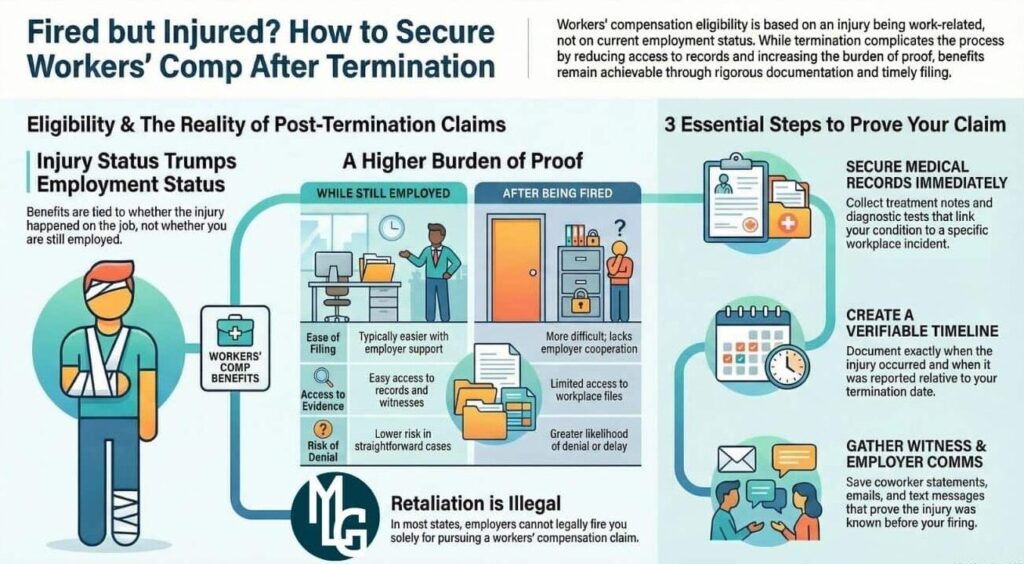
Yes, you can still collect workers’ compensation after being fired, as eligibility is based on the injury being work-related, not your employment status. Termination does not automatically disqualify you from benefits, though it may complicate the claims process and require careful documentation of your injury and employment history. To protect your rights, promptly file your claim, gather all relevant evidence, and consider consulting a workers’ comp attorney to navigate any disputes with your former employer or the insurance carrier.
At Mercer Legal Group, our attorneys have extensive experience helping employees understand whether they can collect workers’ comp after being fired and how to protect their rights. We’ve guided clients through complex post-termination claims, employer disputes, and denied benefits, giving us the insight to identify when an injury remains compensable under the law. Our team stays current on state-specific workers’ compensation rules and retaliation protections, ensuring our guidance is accurate and reliable. If you were injured at work and later terminated, contact us today to discuss your options and get trusted legal guidance tailored to your situation.
In this post, we will explore whether you can receive workers’ comp benefits after being fired, the challenges you might face, and the key steps and evidence needed to secure your claim.
What Determines Eligibility for Workers’ Comp After Firing?
Workers’ compensation is insurance that provides benefits to employees injured or made ill by their job. It covers medical care and partial wage replacement regardless of fault.
Not everyone who is fired remains eligible for workers’ compensation benefits, but several key criteria determine whether you can still claim benefits. Understanding these factors under federal and state laws and workers’ compensation laws can help you protect your rights and ensure your claim is handled correctly.
To get workers’ comp after being fired, the injury or illness must have happened while you were employed, and filing a claim can’t be the reason for your firing. In most states, it is illegal for employers to terminate an employee solely for pursuing workers’ comp insurance benefits, meaning your eligibility is generally protected if your termination was unrelated to the claim.
Certain types of misconduct can significantly affect eligibility. For example, if an employee is terminated for violating workplace policies unrelated to the injury, some states may scrutinize whether the misconduct affects benefit eligibility. Understanding how these conditions apply in your situation is crucial, particularly when other workplace issues arise. Accessing timely medical assistance and knowing your rights under workers’ compensation laws can significantly impact the success of your claim.
What Are State-Specific Rules That Determine Eligibility for Workers’ Comp Benefits?
Eligibility for workers’ comp can vary depending on state law. Some states have unique rules regarding post-termination claims, including specific deadlines for filing after employment ends or additional documentation requirements. Knowing your state’s requirements is crucial to avoid losing benefits.
For example, California allows terminated employees to continue receiving benefits for work-related injuries, while other states may require claims to be submitted within a shorter period after firing. State laws also influence the type and amount of compensation you can receive, including medical treatment, wage replacement, and vocational rehabilitation, making it essential to review local regulations carefully.
How Does the Legal Process Work?

Applying for workers’ compensation after being fired can feel intimidating, but the legal process is often more straightforward than people expect. Understanding each step helps protect your rights and ensures you don’t miss critical deadlines that could affect your benefits.
Filing a Claim
The process typically begins by formally filing a workers’ compensation claim with your employer’s insurance carrier or the state workers’ comp board, even if your employment has already ended. You must demonstrate that the injury occurred while you were still employed and that you properly reported it, which usually involves medical records, incident reports, witness statements, and any written communication with your employer.
Timing is crucial. Most states impose strict deadlines for reporting the injury and submitting your claim, and missing them can jeopardize your case. Because termination can sometimes overlap with other workplace issues, such as discrimination or retaliation, seeking legal assistance is important to understand your broader workplace rights and ensure your claim is properly handled.
Why You Need Legal Representation for Workers’ Compensation Claims?
Hiring legal counsel can profoundly influence your claim, particularly if you file it after termination. An experienced workers’ compensation attorney understands how insurance providers evaluate these claims and can help present clear evidence that your injury is work-related, not a result of your firing.
Lawyers also manage communication with the insurance provider, monitor deadlines, and resolve any disputes arising from denied or delayed benefits. Having legal representation puts you in a stronger position to confidently navigate the process, steer clear of costly mistakes, and vigorously pursue the full benefits you legally deserve.
How to Prove Your Injury Is Work-Related After Being Fired?
Proving that your injury is work-related after being fired is critical to protecting your workers’ compensation claim. According to our associate attorney, Sara Salinas, “Even after termination, workers’ compensation is achievable if you know the steps to follow.”
A clear, step-by-step approach is essential to establish the connection between your job and your injury, even when your former employer disputes responsibility. Below are the steps we recommend following to prove your injury is work-related.
Step 1: Gather Medical Records Immediately
Start by collecting all medical reports pertinent to your injury. This includes initial treatment notes, diagnostic tests, medical bills, doctors’ reports, and follow-up care that link your condition to a workplace incident. Medical documentation created close in time to the injury is especially persuasive.
Step 2: Create a Clear Timeline of Events
Outline a detailed timeline showing when the injury occurred, when it was reported, when medical treatment began, and when your employment ended. A consistent timeline helps demonstrate that the injury happened during your employment and was not caused by events after termination.
Step 3: Secure Witness Statements
Identify coworkers who saw the accident or were aware of the conditions that caused your injury. Written or recorded statements from witnesses can confirm how and when the injury occurred, strengthening your claim when an employer disputes responsibility.
Step 4: Collect Employer Communications
Save emails, text messages, incident reports, termination notices, and performance reviews. These records can demonstrate that your injury was reported before you were fired and effectively counter claims that your termination was unrelated or justified by other reasons.
Step 5: Organize and Present Evidence Together
Combine medical records, timelines, witness statements, and employer communications into a single, organized file. Presenting consistent and well-documented evidence makes it easier for insurers, judges, or attorneys to clearly see that your injury is work-related, even after termination.
What Evidence Is Required?

Successfully securing Workers’ Compensation after being fired necessitates robust evidence to prove that your injury is work-related. Identifying and organizing the right types of evidence is crucial in determining the difference between an approved claim and a denied one.
According to our founding partner Simon Moshkovich, “A strong claim relies on thorough evidence.” Medical records, witness statements, and clear timelines are the backbone of proving your injury is work-related.”
Documentation
To receive workers’ compensation benefits, compiling thorough documentation is essential. Key documents include records of medical expenses and accident reports that detail the nature and cause of your injury, as well as any treatment you received. Employment records showing the reasons for your termination can also be crucial, especially if your firing is related to your injury or claim, helping establish a timeline and context for your case.
Witness Statements
Witness testimonies play a vital role in supporting your claim. Statements from coworkers who observed the accident or can confirm the circumstances of your injury help corroborate your account. The strongest claims often combine these testimonies with medical records and other documentation, creating a consistent and convincing narrative for the workers’ comp review process.
What Challenges Might You Face?
Pursuing Workers’ Compensation after being fired presents several challenges for injured employees. One of the main obstacles involves proving that your injury occurred while performing job-related duties, especially if your employer disputes the claim after termination. Employers and their insurance company may argue that the injury did not happen on the job or isn’t severe enough to warrant benefits, rendering documentation, witness statements, and medical records essential.
Navigating the timing of your claim can also be tricky. Workers’ comp laws require prompt reporting, and delays caused by termination disputes may complicate the process. Understanding workers’ compensation rules and procedures is essential to protect your rights and ensure your claim stays valid.
Another common hurdle involves addressing employer retaliation or skepticism from claims adjusters. Even though firing an employee for filing a workers’ comp claim is illegal in most states, terminated workers often face skepticism that can slow approval or reduce benefits. Legal guidance can help injured employees communicate effectively with the employer’s insurance company, ensure all evidence is properly submitted, and maximize their chances of receiving full benefits.
Employer Retaliation
Employer retaliation can complicate workers’ compensation cases after a job termination. Retaliation occurs when an employer punishes a worker for reporting an injury, filing a workers’ compensation claim, or otherwise exercising their legal rights. Common indicators include sudden termination, reduced hours, disciplinary write-ups, or negative performance reviews that appear after the injury is reported.
Retaliation can affect a worker’s comp claim by discouraging employees from pursuing benefits or by creating disputes over workers’ compensation eligibility. Employers may argue that the job termination was for unrelated reasons, making it harder to prove a connection between the injury and the firing. This can lead to delays, denials, or increased scrutiny of the claim, and in some cases may constitute wrongful termination.
To address Workers’ Comp retaliation effectively, please ensure that you keep all relevant records of injury reports, emails, termination notices, and timelines showing what happened and when. Reporting retaliation to the appropriate agency and consulting an employment or workers’ comp attorney can help protect your rights and hold the employer accountable.
How Are Disputes Resolved in Workers’ Comp Claim?
Disputes between an employee and employer over workers’ compensation are typically handled through formal resolution processes. Many cases begin with mediation, where a neutral third party assists both sides in reaching an agreement without going to court. If mediation fails, the dispute may move to a workers’ compensation hearing or court intervention, where a judge reviews the evidence and makes a binding decision.
Timelines for dispute resolution vary depending on the complexity of the case and the level of disagreement. Some disputes are resolved within weeks through mediation, while others can take several months if hearings, appeals, or additional medical evaluations are required. Outcomes may include approval of benefits, medical coverage, financial support for lost wages, modified compensation, or denial of the claim, depending on the strength of the evidence presented.
Workers’ Comp After Being Fired vs. While Still Employed
Understanding the differences between filing for workers’ compensation after being fired versus while still employed helps set realistic expectations and avoid surprises. While eligibility for benefits generally remains the same, the process and level of resistance you may face differ significantly.
| Factor | After Being Fired | While Still Employed |
|---|---|---|
| Eligibility for Benefits | Still eligible if the injury is work-related | Still eligible if the injury is work-related |
| Ease of Filing | Often more difficult due to a lack of employer cooperation | Typically easier with employer access and support |
| Employer Cooperation | Frequently reduced or adversarial | Usually higher and more responsive |
| Burden of Proof | Higher must clearly prove injury occurred during employment | Lower-injury connection is often less disputed |
| Risk of Disputes or Denial | Greater likelihood of denial or delay | Lower risk in straightforward claims |
| Access to Evidence | Limited access to workplace records and witnesses | Easier access to documents and coworkers |
| Need for Legal Help | Strongly recommended due to added complexity | May not be necessary for simple cases |
Deadlines to File Workers’ Comp After Termination
Filing deadlines are critical when pursuing workers’ compensation after being fired. Most states require that you report your injury and submit a claim within a defined period. Missing these deadlines can result in denied benefits, even if your injury is clearly work-related. Acting quickly helps protect your workers’ compensation eligibility and ensures your claim stays valid.
At Mercer Legal Group, we advise our clients, “Time is critical when filing a claim following termination.” Acting promptly can protect your benefits and prevent unnecessary delays that might also affect unemployment benefits.
Deadlines vary by state and type of injury. Some states allow several months after termination, while others have shorter time limits. Keep track of all dates, including when the injury occurred, when it was reported, and your termination date. Consulting a workers’ comp attorney who specializes in employment law can help you meet deadlines, safeguard your legal rights, and avoid mistakes that could jeopardize your claim.
When to Contact an Employment or Workers’ Comp Attorney?

You should contact an attorney as soon as you face challenges with your workers’ comp claim after your employer fires you, including cases of retaliatory termination, disputed injuries, or delays in filing. Early legal guidance ensures your legal rights are protected, helps document your claim properly, and guides you through the workers’ comp process.
An attorney working on a contingency fee basis is essential if your claim is denied or deadlines are approaching. They can gather evidence, communicate with insurers, and represent you on legal grounds to help maximize compensation, including wage replacement benefits and coverage for necessary medical attention. Having professional guidance increases your chances of receiving full benefits and reduces the risk of errors during the claims process.
Have You Been Fired Unfairly and Denied Workers’ Comp?
In this blog, we explored whether you can collect Workers’ Compensation after being fired, emphasizing that your Workers’ Comp eligibility is based on the injury being work-related, not your employment status. We discussed common challenges, such as employer disputes, delays in filing, and skepticism from claims adjusters, and highlighted the importance of collecting robust evidence, including medical records, accident reports, employment documents, and witness statements to support your claim.
While being terminated complicates the process, it does not preclude you from pursuing benefits. Knowing and protecting your legal rights is imperative, and taking the right steps early can make a significant difference. Consulting an experienced employment or workers’ compensation attorney can help safeguard your legal rights, ensure your claim is properly documented, and increase your chances of receiving the benefits you deserve.
Can you collect workers’ comp after being fired? At Mercer Legal Group, we help injured workers understand their rights and pursue Workers’ Compensation benefits even after termination. Our experienced employment attorneys in California have hands-on experience handling post-termination claims and challenging employer pushback. Contact us today for a free consultation and strong legal support for your case.
Frequently Asked Questions
If you’ve been fired but suffered a work-related injury, you might be wondering, “Can you collect workers’ comp after being fired?” This FAQ section answers common questions about eligibility, filing, and potential challenges after termination.
How to File for Workers’ Comp After Being Fired?
You can still file a workers’ compensation claim after being fired, as long as the injury or illness is work-related and occurred during your employment. Act quickly by reporting the workplace injury to your former employer, seeking medical care, and filing a claim with the state workers’ compensation board; an employment attorney can help protect your rights if the termination was retaliatory.
Can I Still Claim Workers’ Comp if I Was Fired for Misconduct?
Yes, you can still claim workers’ compensation under legal protections even if you were fired for misconduct, as long as the workplace injury happened in the course of your employment. However, benefits may be denied if the injury resulted from willful misconduct, intoxication, or a violation of safety rules.
Can You Collect Workers’ Comp After Being Fired?
Yes, you can still collect workers’ compensation benefits after being fired, provided your workplace injury or illness is work-related. Your eligibility for collecting benefits generally isn’t affected by termination, though timely filing with the state workers’ comp board is essential.
What Are the Costs Involved in Pursuing Workers’ Comp After Being Fired?
Pursuing workers’ compensation after being fired usually involves minimal upfront costs, as most attorneys work on a contingency basis and are paid a portion of your awarded benefits. You may still incur expenses for medical records or expert reports, but these are often covered or reimbursed if your claim is successful.
Disclaimer: The information provided on this blog is for general informational purposes only and does not constitute legal advice. Reading this content does not create an attorney-client relationship. Laws and regulations vary by jurisdiction and may change over time, so you should consult a qualified employment attorney for advice regarding your specific situation. Past examples, case studies, or hypothetical scenarios are illustrative only and do not guarantee similar results.