
EIf you were fired for taking protected FMLA leave in California, start by gathering records related to your leave and termination, such as emails, medical certifications, and your termination notice. Then, speak with an employment lawyer as soon as possible to determine whether your employer violated the FMLA, the California Family Rights Act (CFRA), or other state laws. If your rights were violated, you may be able to recover lost wages, get your job back, or seek other compensation.
Getting fired for taking FMLA leave is illegal in California, and Mercer Legal Group goes after employers who try to dress it up as something else. Our attorneys have secured recent results that include a $750,000 disability discrimination settlement and more than $6 million recovered for employees. We work on contingency, so you pay nothing unless we win, and we will tell you straight, in English or Spanish, whether your firing crossed the line. Contact us today for a free case review, because the deadline to act is already running. Fired by a Los Angeles employer specifically? Read how we handle Los Angeles FMLA retaliation claims, including what to preserve before you talk to HR again.
In this blog, we will explain your rights under FMLA and CFRA in California, what counts as illegal termination, and how to take action if you’re fired for taking medical or family leave.
What Is Fired for Taking FMLA in California?

More than half (56%) of U.S. employees are eligible for FMLA protections, according to the U.S. Department of Labor’s 2018 FMLA Employee Survey. Being fired for taking FMLA leave in California may amount to unlawful retaliation if the leave was legally protected.
The Family and Medical Leave Act (FMLA) and the federal medical leave actallow eligible employees to take unpaid leave or job-protected leave for their own serious health condition, to care for a qualifying family member, or for certain other covered reasons. California also provides protections under the California Family Rights Act (CFRA), which expands leave rights in many situations and covers some employees who may not qualify under federal law.
To receive protection, employees must meet certain eligibility requirements. In most cases, FMLA applies to employees who have worked for a covered employer for at least 12 months and logged at least 1,250 hours during the previous year. Both FMLA and CFRA generally provide up to 12 weeks of protected leave within a 12-month period. Depending on the circumstances, employees may also be able to use available paid sick leave or other accrued paid time off during their leave.
Employers have important responsibilities while an employee is on approved medical leave. They must continue the employee’s group health insurance under the same terms as if the employee were still working.
When the leave ends, the employee is generally entitled to return to the same job or a comparable position with similar pay, benefits, and working conditions. Employees may also request reasonable accommodations if they need support when returning to work. According to our associate attorney at Mercer Legal Group, Sara Salinas, “Being fired shortly after requesting leave or returning from protected leave is a major red flag that your rights may have been violated.”
Many employees believe they can never be fired while on FMLA or CFRA leave. That is not always true. An employer may still terminate an employee for legitimate reasons that are completely unrelated to the leave, such as a company-wide layoff or documented performance issues. However, employers cannot use protected leave as the reason for the termination or interfere with an employee’s right to take leave.
If an employer punishes or fires an employee for taking protected medical leave, it may be an FMLA violation. Employees may have the right to recover lost wages, benefits, and other damages. Knowing how these laws work can help employees protect their jobs and respond quickly if their rights have been violated.
Examples of FMLA Violations
When an employee takes FMLA leave, employers infringe upon an employee’s entitlement to protected leave; they commit FMLA violations. For instance, retaliation for taking leave is a prevalent instance. An employee using FMLA for a serious health condition, pregnancy disability leave, or caring for family members may face demotion, reduced hours, or termination. These actions violate federal and California law, even if the employee had legitimate reasons for his or her absence.
Another example is the denial of reasonable accommodations or paid sick leave. Employers must honor job protection and allow employees to use FMLA leave for up to four months if medically necessary. Denying paid sick leave, temporary leave or failing to provide reasonable accommodations, like flexible scheduling for intermittent leave, constitutes a violation. Employees must be able to take leave without fear of losing their position or benefits.
What Are the Steps to Protect Yourself Before Taking a Family and Medical Leave?
Taking FMLA leave in California is your right, but proper preparation helps protect your job and benefits. Employees who plan can avoid disputes and ensure their protected time is respected. Following clear steps makes it easier to prove leave was taken for valid reasons and strengthens any potential legal claim. We recommend following the steps below before taking medical leave:
1. Proper Documentation of Medical Reasons
Keep detailed medical records and certifications to show that the leave is necessary for valid reasons. This documentation supports intermittent leave or extended absences and recovery time and proves the employee’s request is legitimate.
2. Notifying Your Employer and Confirming Approval in Writing
Inform your employer as soon as possible about your need for leave and get confirmation in writing. This ensures that your protected time is recognized and reduces the chance of disputes when the employee returns.
3. Using Paid Time Off Concurrently with FMLA
If available, use accrued paid time off concurrently with FMLA leave. This can maintain income while keeping the employee’s job protected and demonstrating good-faith compliance with company policies, and reducing unpaid time away from work.
Hypothetical Case Example
Jane, a California employee, needed intermittent leave to care for her seriously ill parent. She provided medical certifications, submitted her employee’s request in writing, and coordinated paid time off with her leave. When her employer tried to give her a negative performance review, Jane showed her documentation and confirmed approval emails. Because she took these steps, the company reinstated her position, respected her protected time, and she successfully avoided wrongful termination.
What Are Legal Processes and Procedures for Filing an FMLA Claim?

If the company terminated your employment, there are clear legal processes to follow if the company fires an employee for taking FMLA. Acting quickly helps protect rights and potential compensation. If you have been fired for taking a medical leave, we recommend following the steps below to file a claim:
Step 1: Document Everything
Keep records of leave requests, employer correspondence, medical certifications, and any disciplinary actions. These documents help prove FMLA violations and support claims under fair employment standards.
Step 2: Contact the Department of Labor
File a complaint with the U.S. Department of Labor’s Wage and Hour Division or the California Department of Fair Employment and Housing. The Equal Employment Opportunity Commission can also help if discrimination overlaps with the FMLA violation.
Step 3: Seek Legal Counsel
An experienced employment attorney can guide you through filing a lawsuit if needed. They guarantee the enforcement of your rights under the FMLA and CFRA, and they have the authority to seek reinstatement, lost wages, and damages for emotional distress.
Step 4: Follow Court Procedures
Your FMLA attorney will handle filings, discovery, and hearings. Courts have the authority to grant compensation, benefits, and occasionally even court costs, guaranteeing the protection of employees under both state and federal laws.
Common Reasons Employers Illegally Fire Employees on Medical Leave
One of the most common reasons employees are wrongfully terminated during medical leave is retaliation. An employer cannot legally fire, demote, or discipline someone simply because they requested or used protected leave under the FMLA or CFRA.
If a worker is dismissed soon after taking leave, especially without a clear business reason, the timing may suggest unlawful retaliation or any other adverse action. Employers also cannot interfere with an employee’s right to take approved leave or discourage them from using it.
Some workers also face discrimination because of a medical condition or disability. An employer cannot make employment decisions based on assumptions about a person’s health or ability to work. In many cases, employers must also provide reasonable accommodations that allow an employee to perform the essential duties of the job once they are able to return. Refusing to discuss accommodations, undue hardship, or terminating an employee instead of considering reasonable options may violate state or federal law.
Wrongful termination is not always direct. Some employers try to force employees to quit by cutting their hours, removing important job duties, creating a hostile work environment, or making it impossible to return after medical leave. This is known as constructive dismissal. Even if an employee resigns, the employer may still be held responsible if its actions effectively left the employee with no reasonable choice but to leave.
How Do You Gather Evidence and Documentation for an FMLA Claim?
Gathering evidence for an FMLA claim is crucial. Start with medical records and medical certifications that show the need for leave for medical reasons. These documents prove the leave was legitimate and protected under the law.
Next, collect all correspondence with your employer about taking medical leave. Emails, letters, or messages showing approval or denial can support claims of FMLA interference. Keep records of any disciplinary actions that occurred during or after your leave.
Also, gather performance reviews before and after taking leave. Positive reviews before taking leave can show termination or discipline was not due to job performance. According to Simon Moshkovich, founding partner at Mercer Legal Group, “Having an experienced employment lawyer levels the playing field against employers who have legal teams working to protect the company.”
Filing FMLA Claims Yourself vs. Hiring an Employment Lawyer
When facing a potential FMLA claim, employees often wonder whether to handle it themselves or hire an employment lawyer. We have prepared the table below to help you weigh the risks, benefits, and potential outcomes of each approach.
| Factor | Filing Yourself | Hiring an Employment Lawyer |
|---|---|---|
| Knowledge of Law | Must learn the federal FMLA and California CFRA rules on your own | A lawyer understands state and federal law, including job protections and paid leave entitlements |
| Documentation | Employee must track medical records, emails, and performance reviews | A lawyer can help organize evidence to strengthen the case, including intermittent leave and employees’ requests, while also protecting you from your employer attempting to label your claim as a frivolous lawsuit. |
| Likelihood of Success | Risk of mistakes, missed deadlines, or improperly filing complaints | Higher chance of success due to expertise in avoiding common FMLA claim errors |
| Compensation Recovery | May only recover basic back pay; it’s hard to claim emotional distress or attorney fees | Can pursue full compensation, including lost wages, benefits, emotional distress, and court costs |
| Time & Stress | Employee handles all research, filings, and communication with the employer and agencies | A lawyer manages filings, negotiations, and court procedures, reducing stress for the employee |
| Cost | The service is free, but employees face a risk of receiving a lower recovery amount. | Legal fees may apply, but many firms offer free consultations and may work on contingency |
What Are the Potential Remedies and Compensation for Wrongful Termination in California?
If you were wrongfully fired for taking protected medical leave, you may have several legal remedies. Depending on the facts of your case, you could be reinstated to your former job or a similar position. You may also recover back pay, lost benefits, and other income you missed because of the termination, through legal action.
Some employees may also qualify for compensation beyond lost wages. If the termination caused emotional distress, the court may award damages for that harm. In cases involving especially reckless or intentional misconduct, punitive damages may also be available to punish the employer and discourage similar conduct.
Not every case ends up in court. Many wrongful termination claims are resolved through a settlement before trial. A settlement can often save time and reduce legal costs, while a lawsuit may be the better option if the employer refuses to offer fair compensation.
It is also important to act quickly. California employment claims are subject to filing deadlines, and the time limit depends on the law involved and the facts of your case. Waiting too long could prevent you from recovering compensation, even if your claim is valid.
The remedies available in your case will depend on the evidence and the laws that apply. An employment lawyer can review your situation, explain your options, and help you pursue the compensation you may be entitled to.
Ready to Fight for Your FMLA Rights?
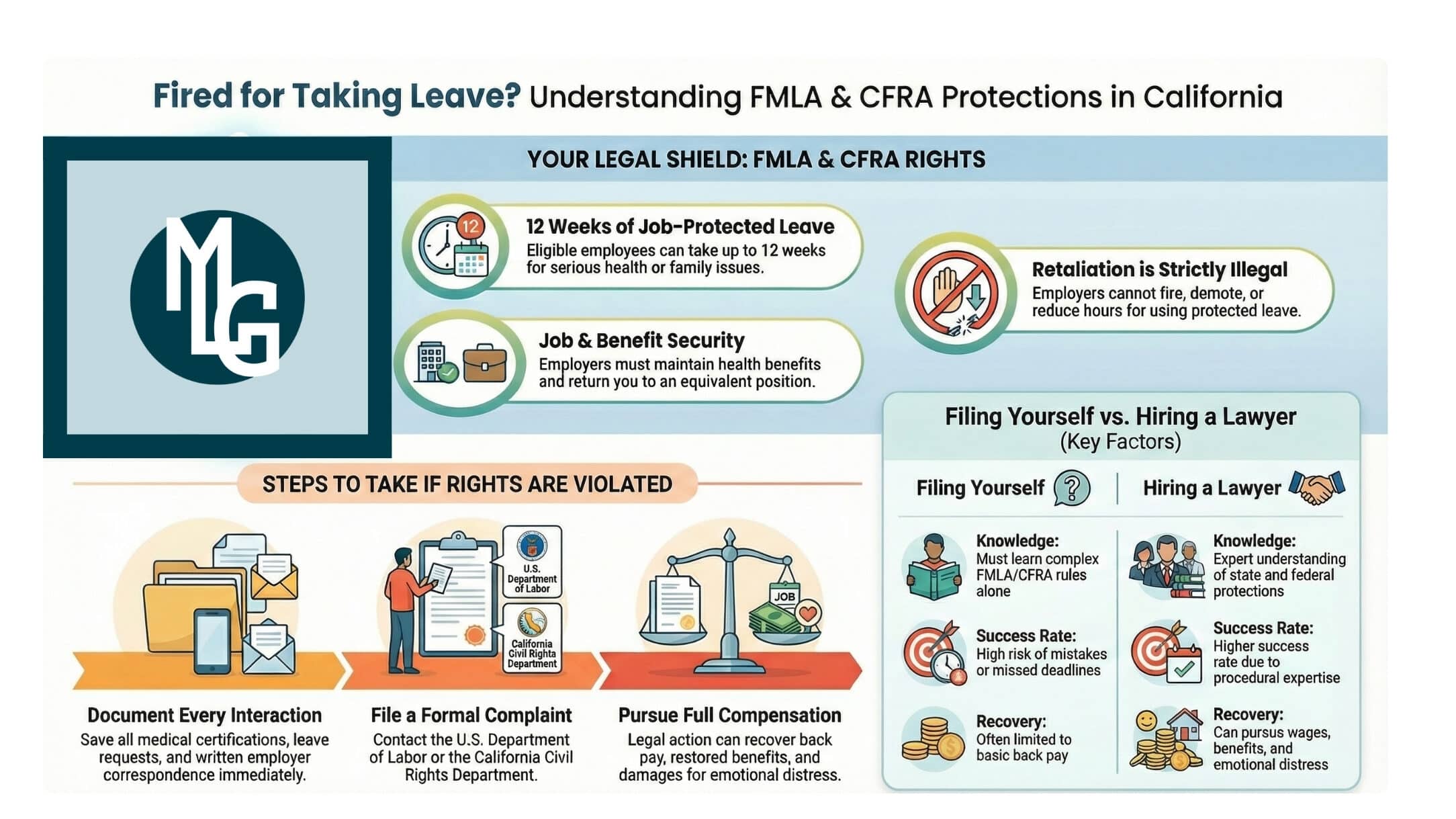
Being fired for taking FMLA in California is illegal under both federal law and the California Family Rights Act (CFRA). Eligible employees can take up to 12 weeks of unpaid, job-protected leave for serious health conditions or family care. Employers cannot retaliate, deny benefits, or interfere with FMLA rights. Employees should keep detailed records of leave requests, medical certifications, employer communications, and any disciplinary actions.
If your rights are violated, legal recourse is available. You may be entitled to reinstatement, back pay, benefits, and damages for emotional distress. Filing a complaint with the U.S. Department of Labor or the California Department of Fair Employment and Housing is a key step. Consulting a qualified FMLA lawyer can help protect your rights, gather evidence, and pursue claims effectively. Acting quickly increases your chances of a successful outcome.
Think you were fired for taking FMLA leave? Mercer Legal Group has recovered more than $6 million for employees, including a recent $750,000 disability discrimination settlement. Our expert employment lawyers in California fight employers who try to disguise illegal retaliation as a “business decision” and give you an honest assessment of your case in English or Spanish. Your consultation is free, you pay nothing unless we win, and the clock to protect your rights is already ticking. Contact us today.
Frequently Asked Questions
California employees often have questions about their rights while taking FMLA leave. Here are quick answers to common questions about job protection, qualifying conditions, and medical leave.
Can You Be Fired While on FMLA Leave in California?
No, an employer cannot legally fire you simply for taking protected FMLA leave. However, you may still be terminated for legitimate reasons that are unrelated to your leave.
Does Bronchitis Qualify for FMLA?
Bronchitis may qualify for FMLA if it is a serious health condition that requires ongoing treatment or inpatient care. Minor cases that resolve quickly usually do not qualify.
Can You Get FMLA for Neuropathy?
Yes, neuropathy may qualify for FMLA if it seriously affects your ability to work or requires ongoing medical treatment. Your healthcare provider may need to certify the condition.
Can I Get Fired for Taking FMLA Leave?
No, it is illegal for an employer to fire you because you took protected FMLA leave. If this happens, you may have legal options to challenge the termination.
How Long Does an Employer Have to Hold a Job for Someone on Medical Leave?
Eligible employees are generally entitled to up to two weeks to 12 weeks of job-protected leave under the FMLA. In some situations, California law may provide additional leave or workplace protections.
Disclaimer: The information provided on this blog is for general informational purposes only and does not constitute legal advice. Reading this content does not create an attorney-client relationship. Laws and regulations vary by jurisdiction and may change over time, so you should consult a qualified FMLA attorney for advice regarding your specific situation. Past examples, case studies, or hypothetical scenarios are illustrative only and do not guarantee similar results.