

Attorney Advertising.
Wrongful termination due to disability happens when a California employer fires you because of a physical or mental impairment, a medical condition, or a disability they only believe you have. Wrongful termination is the broader category, covering any firing that breaks the law rather than one that simply feels unfair. Understanding your rights matters here, because most people go looking for them only after the job is already gone.
Mercer Legal Group represents California employees in disability discrimination and wrongful termination cases, and never represents employers. Simon Moshkovich, admitted to the California Bar in December 2018 after practicing at Skadden Arps and Latham & Watkins, recovered $300,000 in 2024 for a Southern California employee terminated after her employer failed to accommodate her. The firm’s attorneys have been involved in matters resulting in recoveries totaling over $8 million, and cases are handled on contingency, so there is no fee unless there is a recovery. Past results do not guarantee future outcomes. If your employer fired you after you disclosed a health condition or asked for help doing your job, contact us for a free case evaluation.
Below we cover how disability is defined at work, what reasonable accommodation and undue hardship mean, what an employer can ask about your health, and the steps to take if you were wrongfully terminated.
What Is Disability in Employment?
TheAmericans with Disabilities Act (ADA) defines disability in three ways. You qualify if you have a physical or mental impairment that substantially limits a major life activity, if you have a record of one, or if your employer regards you as having one. That third prong covers perceived disability, and it matters more than people expect.
An employer can break the law over a condition you do not actually have. There is one catch, though: the "regarded as" route alone does not entitle you to an accommodation, only to protection from discriminatory conduct.
So what counts as a major life activity? Under the federal ADA, the list includes walking, seeing, hearing, sleeping, lifting, concentrating, manual tasks, and working, plus major bodily function categories like the immune, neurological, and endocrine systems. Since Congress amended the statute in 2008, "substantially limits" is construed broadly, and your condition is assessed without regard to medication or devices that help you manage it. California goes further still.
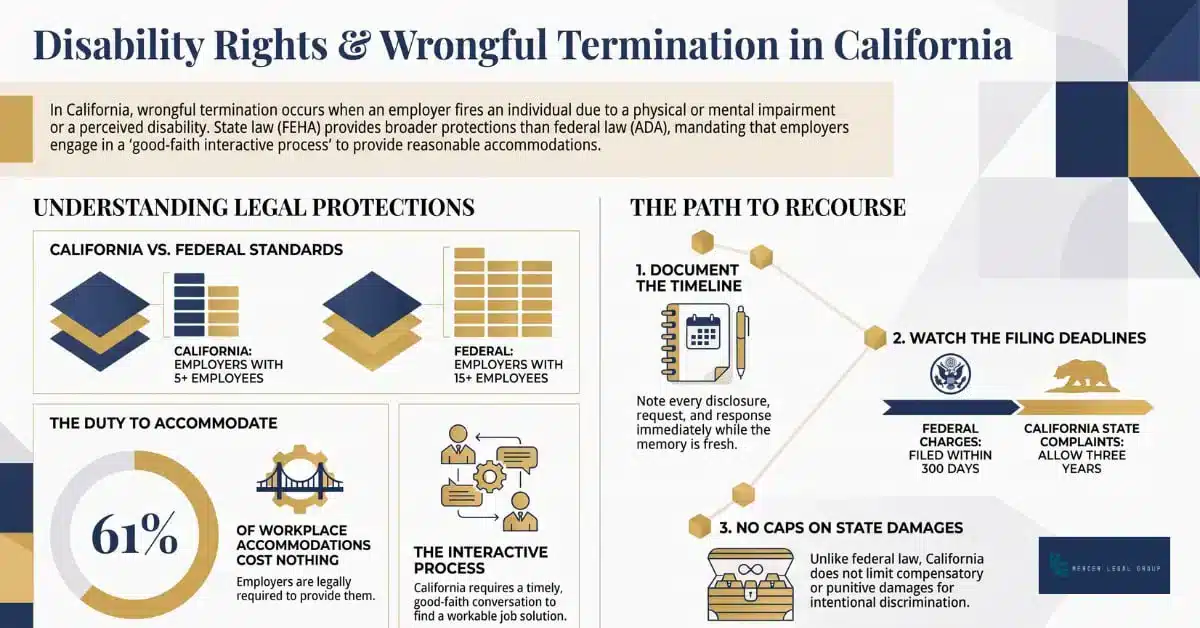
Under theFair Employment and Housing Act, a physical or mental condition qualifies if it merely limits a major life activity, meaning it makes that activity difficult, and state law treats physical disability and mental disability as separate protected categories. State law also covers employers with five or more employees, while the ADA reaches only those with fifteen or more. That gap means a worker at an eight-person company has no federal claim but a full state one.
Given those definitions, employers have clear obligations once a disability arises. Workplace discrimination law bars them from refusing to hire, demoting, or firing qualified employees because of a person’s disability, and it requires them to provide reasonable accommodations for employees with disabilities absent undue hardship.
California adds a separate statutory duty on top of that: employers must engage in a timely, good-faith interactive process once an employee’s disability is known. That last duty stands as its own claim under state law, so an employer can be liable for how it handled the conversation even if the accommodation itself proved unworkable.
These protections run to qualified individuals, meaning people who can perform essential job functions with or without accommodation. The question is whether the employee can do his or her job with reasonable help, not whether the condition exists, and essential functions are the core job duties rather than every line in the description.
The volume of cases here is not small: the Equal Employment Opportunity Commissionreceived 36,256 disability charges in fiscal year 2025, 41.1% of every charge filed that year, recovering $192.05 million administratively. At the state level, California’sCivil Rights Department 2024 report lists disability in 14,430 of 16,924 employment right-to-sue complaints.
Reasonable Accommodation and Undue Hardship
A reasonable accommodation is a change to how, when, or where work gets done so a person with a disability can do the job. The statute names examples directly: job restructuring, part-time or modified work schedules, reassignment to a vacant position, modified equipment, adjusted training materials or policies, qualified readers or interpreters, and accessible facilities.
In practice, that means assistive technology for a low-vision analyst, a lifting restriction honored for a warehouse worker, or unpaid leave while someone recovers. Employers often assume cost is the obstacle, but theJob Accommodation Network reports that 61% of employers who provided cost data said the accommodation cost nothing, with a median one-time cost of $300 among those who spent anything.
Given how little most accommodations cost, asking for one is simpler than people think. You do not need a form, the words "reasonable accommodation," or a diagnosis to start. Tell your supervisor or HR that a health condition is affecting part of your job, then put it in writing the same day. The employer should discuss options and may request reasonable documentation of the limitation. What it cannot do is ignore such requests, stall indefinitely, or hand you one take-it-or-leave-it option and call the conversation finished.
Of course, an employer can push back, and undue hardship is the defense it turns to. It means significant difficulty or expense, not mild inconvenience. Federal and California law weigh the same factors: the nature and cost of the accommodation, the financial resources of the facility and the business overall, the number of employees, the type of operation and workforce structure, and how the site relates to the larger company.
A national retailer will struggle to argue a $300 chair breaks the budget; a six-person shop resisting a full-time assistant stands on firmer ground. The analysis is specific to the employer, which is why blanket policies applied identically to everyone can lead to trouble for employers.
These principles play out clearly in the case law. InHumphrey v. Memorial Hospitals Association, 239 F.3d 1128 (9th Cir. 2001), the Ninth Circuit held that the interactive process is ongoing, so an employer that stops after one failed attempt has not satisfied it, and confirmed that leave can itself be a reasonable accommodation.

What Are Disability-Related Questions and Medical Exams?
What an employer may ask about your health depends on where you are in the hiring process, and the rules shift at two specific points. The table below sets out the three stages.
| Stage | Disability-related questions and medical exams | Key limit |
|---|---|---|
Before a job offer |
Not permitted |
May only ask if you need an accommodation for the application process |
After an offer, before you start |
Permitted, and need not be job-related |
Must be required of all entering employees in the same job category |
During employment |
Only if job-related and consistent with business necessity |
Cannot become a fishing expedition after you disclose a condition |
Protecting Your Privacy
Medical information about you is confidential by law. An employer must keep it on separate forms in a separate medical file, not your personnel file, and treat it as a confidential medical record. Three narrow exceptions apply: supervisors may be told of necessary work restrictions and accommodations, first aid and safety personnel may be told if your condition could require emergency treatment, and government officials investigating compliance may review relevant records. Your diagnosis is not something coworkers are entitled to hear.
If that confidentiality breaks, document it immediately. Write down who disclosed what, to whom, and when you learned of it, and save any email or meeting note showing it happened. Report it internally in writing so the company cannot later claim it had no idea.
A privacy breach can support a claim on its own, and it is strong evidence in a larger case, particularly where disparaging comments about a person’s disability started circulating, and the work environment turned at the same time.
What Are the Legal Implications of Wrongful Termination Due to Disability?
Several disability discrimination laws can apply to one firing. The Americans with Disabilities Act covers private employers with fifteen or more employees. The Rehabilitation Act of 1973 covers federal agencies, contractors, and federally funded programs.
California’s Fair Employment and Housing Act covers employers with five or more, and the federalFamily and Medical Leave Act and its state counterpart protect leave for a serious health condition, which is often where a disability wrongful termination claim begins. Most California employees have claims under more than one at once.
The differences between federal law and state law are not cosmetic, and they change what a disability discrimination lawsuit is worth. The ADA caps combined compensatory and punitive damages by employer size, from $50,000 for smaller employers to $300,000 above 500 employees, though back pay and lost wages sit outside that cap.
California imposes no comparable ceiling, so compensatory damages for emotional distress caused by the termination, and punitive damages where the discriminatory conduct was intentional, are limited by the evidence rather than a statutory number. Deadlines differ too. AnEqual Employment Opportunity Commission charge is due within 300 days in California, while a state Civil Rights Department complaint can be filed for three years.
What Are the Steps to Take If Wrongfully Terminated for a Disability?
If you believe your employer fired you over a disability, the sequence below protects a claim best. Each step builds the record the next one depends on.
- Gather evidence and documentation
- Write a timeline while it is fresh
- File with the EEOC or the Civil Rights Department
- Request a right-to-sue notice
- Talk to a wrongful termination attorney early
Step 1. Gather evidence and documentation
Collect your personnel file, performance reviews, accommodation requests, doctor’s notes, termination paperwork, and any message where someone mentions your health condition. Send anything stored only on a work account to yourself before access is cut off, which usually happens the same day.
Step 2. Write a timeline while it is fresh
Note when you disclosed your condition or requested an accommodation, who you told, how they responded, and every adverse employment action that followed. Proximity between your request and your firing is among the strongest evidence available.
Step 3. File with the EEOC or the Civil Rights Department
You generally must file an administrative charge before suing, and in California either agency works, since the two share complaints under a work-sharing agreement. Watch the clock, because the federal deadline is 300 days from the discriminatory act.
Step 4. Request a right-to-sue notice
In California you can ask the Civil Rights Department for an immediate right-to-sue letter instead of waiting out an investigation. Once it issues, you have one year from that date to file a civil action.
Step 5. Talk to a wrongful termination attorney early
An attorney can identify which claims are available, what monetary damages are realistic, and whether a wrongful termination lawsuit belongs in state court, federal court, or both. Most employment attorneys, including Mercer Legal Group, review these cases at no charge.

Resources and Support for Affected Employees
Several government agencies exist to help. TheEqual Employment Opportunity Commission takes federal charges and publishes plain-language guidance on accommodation, medical inquiries, and retaliation.
TheCalifornia Civil Rights Department handles state complaints and issues right-to-sue notices. TheJob Accommodation Network, funded by the U.S. Department of Labor, gives free confidential advice on specific accommodations to employees and employers alike.
Beyond the agencies,Disability Rights California is the state’s federally mandated protection and advocacy organization and offers information and, in some matters, direct representation. Local legal aid offices and county bar referral services help when a case falls outside a private firm’s scope. These are free, and using one does not stop you from hiring a lawyer later.
When you look for legal guidance, ask practical questions: does this attorney represent employees rather than companies, have they tried cases in your county, will the fee arrangement be in writing, and will you speak with an attorney or only with staff? Mercer Legal Group takes disability cases on contingency, with no upfront fees and no fee unless there is a recovery, and handles matters throughout California from its Woodland Hills office and locations in Los Angeles, Riverside, and San Bernardino.

Have You Been Wrongfully Terminated Because of a Disability?
A firing crosses into disability wrongful termination when your physical or mental condition, a record of it, or your employer’s belief about it played a role in the decision. California law defines disability more broadly than federal law, reaches far smaller employers, allows three years to file with the state, and does not cap what a jury can award for emotional distress or punitive damages. The pattern repeats: an employee discloses a condition or asks for an accommodation, and the treatment changes shortly afterward.
If that sounds like what happened to you, get advice before the deadlines run. Bring whatever you have, even if it is incomplete, because a case often turns on a single email or a date that seemed unimportant at the time.
Mercer Legal Group representsCalifornia employees in disability discrimination and wrongful termination cases, and never represents employers. If you have been laid off for having a disability in California, you may have legal options. Contact us for a free case evaluation. Someone is available 24 hours a day, and se habla español.
Frequently Asked Questions
A disability that appears just before a termination is one of the most serious warning signs employees report to us. Here are the questions we hear most often in these cases.
How Can I Prove Wrongful Termination Due to Disability?
Most cases are built on timing, documents, and inconsistency, like an accommodation request followed by a firing weeks later or a shifting explanation for the decision. Personnel files, written records, and witnesses to disparaging comments are all important.
What Are the Consequences for Employers Who Wrongfully Terminate Based on Disability?
An employer can be ordered to pay back pay, front pay, compensatory damages, and attorney’s fees, with reinstatement or punitive damages possible depending on the conduct. Federal claims carry statutory caps tied to company size, but California claims do not.
Can an Employer Terminate an Employee With a Disability?
Yes, for legitimate reasons unrelated to the disability, like documented performance issues, misconduct, or a genuine layoff. What crosses the line is using the disability itself, or a request for accommodation, as the actual reason.
What Should I Do if I Believe I Have Been Wrongfully Terminated Due to a Disability?
Preserve your documents, write a dated timeline, and don’t sign a severance agreement before it’s reviewed, since these often waive claims you don’t realize you have. Then file with the EEOC or the California Civil Rights Department within the deadline, and talk to an attorney about your specific situation.
Disclaimer: This article is for informational purposes only and does not constitute legal advice. Reading it or contacting Mercer Legal Group does not create an attorney-client relationship. Employment law outcomes depend on the specific facts of each case, and no particular result is implied. If you need advice about your situation, consult a licensed California attorney.