
Wrongful termination due to a medical condition happens when your employer fires you because of your health rather than your work. State law treats the issue seriously, and it protects workers far more broadly than most people assume. The common misconception is that at-will employment lets a company fire anyone for any reason, but using a health condition as the reason is illegal, and knowing your legal rights can turn a bad situation into a claim.
Mercer Legal Group represents California employees in disability and medical condition discrimination cases, working from offices in Woodland Hills, Los Angeles, Riverside, and San Bernardino. Simon Moshkovich recovered $300,000 in 2024 for a Southern California worker terminated after her employer failed to accommodate her. Cases are handled on contingency, the phone is answered 24 hours a day, and se habla español. If you were fired soon after a diagnosis, a leave request, or new medical restrictions, contact us today for a free consultation.
Below we cover how to recognize an unlawful firing, which laws protect workers, how to prove the claim, and what to do next.

Recognizing Wrongful Termination Due to Medical Conditions
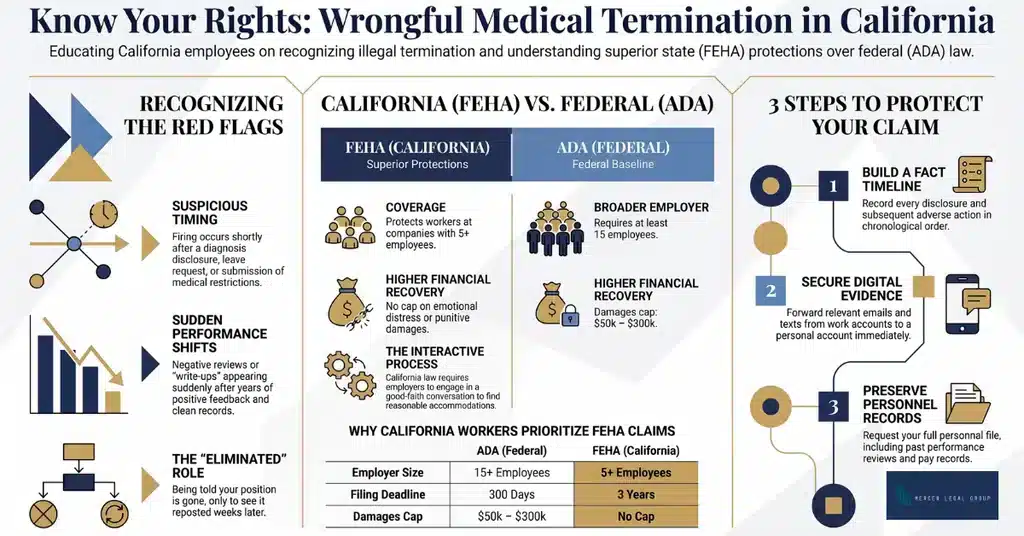
Timing is usually the first clue. You disclose a medical issue, request medical leave, or hand over a doctor’s note with medical restrictions, and the mood changes. Suddenly there are write-ups where there were none, your performance reviews turn negative after years of good ones, or the employer starts cutting hours. A record that was clean until your health came up is the most common pattern in workplace discrimination cases.
Other signs are less subtle. An employer fires someone still out on medical leave, or the day they return. Accommodation requests go unanswered, then the job disappears. A worker is told the role was eliminated, and it is posted again weeks later. Often the stated reason is poor performance nobody mentioned before the diagnosis, which is why the paper trail matters.
California courts see these patterns regularly. In Soria v. Univision Radio Los Angeles, Inc. (2016) 5 Cal.App.5th 570, the Court of Appeal revived a case in which treatment-related absences and a surgery leave request came shortly before the firing, finding triable issues of disability discrimination, failure to accommodate, and leave retaliation. The opposite result is just as instructive.
What Laws Protect Employees from Wrongful Termination?
Several laws overlap here, and most California workers are covered by more than one at once. The framework has two layers: federal statutes that apply nationwide and state law that is broader on nearly every measure. Which fits depends on your employer’s size, your tenure, and your condition.
The Family and Medical Leave Act (FMLA) is the federal leave law. It covers employers with 50 or more employees, and eligible employees are those who have worked 12 months, logged at least 1,250 hours in the past year, and work at a site with 50 employees within 75 miles.
It provides up to 12 workweeks of leave for a serious health condition, your own or a family member’s, and guarantees your job back or an equivalent one with equivalent pay and benefits. Firing someone for taking FMLA leave is interference and retaliation, since the leave itself is protected activity.
The Americans with Disabilities Act (ADA) is the federal disability law. It applies to employers with 15 or more employees and protects a physical or mental impairment that substantially limits a major life activity, a record of one, or being regarded as having one. It is illegal to discriminate on that basis, and employers must provide reasonable accommodations, including reassignment to a vacant position, unless doing so causes undue hardship.
California’s Fair Employment and Housing Act (FEHA) goes further on every front and binds California employers with just five or more employees. It protects a condition that merely limits a major life activity rather than substantially limits it.
FEHA treats medical condition as its own protected category, separate from physical disability and mental disability. Government Code section 12926 defines it narrowly, covering a health impairment tied to a cancer diagnosis or history of cancer, along with a genetic characteristic that carries an increased risk of disease. California’s Family Rights Act adds leave protection at five or more employees, lowered from 50 in January 2021, and pregnancy disability leave runs up to four months.
The key legal protections are consistent across all of them. Your employer cannot fire you, demote you, or take any other adverse employment action because of your health. It must engage in an interactive process when you ask for help doing your job, and hold your position during protected leave. Your employer cannot punish you for asserting these rights, and doing so is a violation even if the underlying discrimination claim does not succeed.
How to Prove Wrongful Termination Due to Medical Condition
Proving one of these cases is a matter of assembling evidence in the right order. Work through these steps.
- Build the Timeline First — Write down when you disclosed your condition, requested medical leave, or handed over restrictions, and then every adverse action that followed. Close timing between the two is the most common circumstantial evidence in wrongful termination cases.
- Collect Your Medical Documentation — Gather diagnosis records, doctor’s notes describing your medical restrictions, leave paperwork, and anything you gave your employer about your health condition. These establish both the protected condition and the employer’s knowledge of it.
- Pull Your Employment Records — Request your personnel file, performance reviews, write-ups, and pay records going back several years. A strong record that turns negative right after your diagnosis persuades far better than any description of it.
- Save the Communications — Emails, texts, and messages about your condition, accommodation requests, or leave are often the only direct proof of what was said. Before access disappears, forward anything on a work account to yourself.
- Identify Your Witnesses — Note colleagues who heard comments, saw the treatment change, or know how comparable employees were handled. Witness statements from people who were there are very important.
- Consult an Employment Attorney Early — A California employment attorney can identify which claims apply, which deadline governs, and what evidence is still recoverable. Most employment lawyers review these cases at no charge.

What Is the Legal Framework of the FEHA and ADA in Wrongful Termination?
Both statutes grew from the same problem at different times. Congress passed the ADA in 1990 to end employment discrimination against people with disabilities, and amended it in 2008 to reverse decisions reading the definition too narrowly. FEHA is older, has been repeatedly expanded, and carries a legislative instruction that its disability protections be construed broadly and independently of federal law.
The scope of each law differs in ways that affect real cases. The ADA reaches employers with 15 or more employees and requires an impairment that substantially limits a major life activity. FEHA reaches five or more and requires only that the condition limit one, meaning it makes the activity difficult. A worker at a nine-person company has no federal claim but does have a complete state claim.
The similarities matter too. Both laws bar discrimination based on a health condition, require reasonable accommodations, cover a record of an impairment and being regarded as having one, and make retaliation unlawful. An employee who can prove one can usually prove the other when both apply.
The sharpest difference is what a case is worth. The ADA caps combined compensatory and punitive damages by employer size, from $50,000 to $300,000 for employers with more than 500 employees, though back pay and lost wages sit outside the cap.
FEHA has no ceiling, so emotional distress and punitive damages are limited by evidence rather than a statutory number. That gap is why California workers generally plead FEHA first.
| Factor | ADA (Federal) | FEHA (California) |
|---|---|---|
| Employer size covered | 15+ employees | 5+ employees |
| Disability standard | Must substantially limit a major life activity | Only needs to limit one |
| Medical condition as its own category | No | Yes (cancer, genetic conditions) |
| Interactive process required | Yes | Yes, and treated as a separate claim |
| Damages cap | $50,000–$300,000 based on employer size | No cap |
| Filing deadline | 300 days (EEOC) | 3 years (Civil Rights Department) |
| Right-to-sue window | 90 days after notice | 1 year after notice |
Application of FEHA in Wrongful Termination Cases
Government Code section 12940 is where FEHA’s operative rules sit. It makes termination unlawful because of a physical disability, mental disability, or medical condition. It requires reasonable accommodation and separately requires a timely, good-faith interactive process once the employer knows about your condition. That second duty is its own claim in California, so an employer can be liable for how it handled the conversation even when no accommodation would have worked.
The cancer protection is the clearest illustration of FEHA’s reach. In Fisher v. Superior Court (1986) 177 Cal.App.3d 779, the Court of Appeal confirmed an employee with cancer was entitled to FEHA’s medical condition protections, and that category still stands separate from disability.
In practice, a cancer diagnosis usually supports both claims at once. Workers with other conditions, such as diabetes or a back injury, are protected too, under the disability categories instead.
Application of ADA in Wrongful Termination Cases
The ADA is the federal floor, and for employees of larger companies, it runs alongside the state claim. It prohibits discrimination in hiring, promotion, discipline, and termination against a qualified individual, meaning someone who can perform the essential functions of the job with or without accommodation. The scale of the problem is not small: the Equal Employment Opportunity Commission received 36,256 disability charges in fiscal year 2025, which was 41.1% of all charges filed that year.
Employer obligations center on accommodation. The statute directly names examples of reasonable accommodations that employers must provide, including modified schedules, job restructuring, modified equipment, and reassignment to a vacant position, unless these accommodations impose undue hardship, which is defined as significant difficulty or expense relative to the employer’s size and resources. What an employer offers matters less than whether it asks at all. Most of these cases turn on a conversation that never happened.
What Are the Steps to Take if You Believe You’re a Victim?
Act on documentation first. Save your medical records, personnel file, and every message about your condition or leave, and write a dated account while it is fresh. Send anything held only on a work system to a personal account before access is cut off, and do not sign a severance agreement before someone reviews it, since those routinely waive claims you may not know you have.
Then file with the right agency. You can file with the Civil Rights Department, which allows three years, or the EEOC, which allows 300 days here because California has its own enforcement agency. The two share complaints under a work-sharing agreement, so filing with one generally preserves the other. Watch the second clock too: a state right-to-sue notice gives you one year to file suit, an EEOC notice only 90 days.
Legal representation matters more than people expect here. Which claims you bring, which agency you file with, and which deadline governs shape a wrongful termination lawsuit before any evidence is argued, and a common law claim for termination in violation of public policy runs on a separate two-year clock with no agency filing at all. Those choices are hard to reverse.

How Can an Attorney Help if You Have Been Wrongfully Terminated Due to a Medical Condition?
An employment attorney’s first job is to see the whole picture. Workers arrive describing one firing, and a lawyer reviewing the file often finds several overlapping claims: disability discrimination, failure to accommodate, failure to engage in the interactive process, FMLA retaliation or CFRA interference, and sometimes a public policy claim on top. Each carries its own proof requirements and deadline, and spotting them early protects the value of the case.
Mercer Legal Group handles employment matters for California workers and does not represent employers. The practice covers wrongful termination, disability discrimination, retaliation, harassment, and wage and hour disputes. Sara Adela Salinas conducts depositions, argues discovery and dispositive motions, and prepares cases for trial in state and federal court.
The firm’s published results in this area are specific rather than general. Simon Moshkovich obtained $300,000 in 2024 for a Southern California employee terminated after a failure to accommodate, along with $300,000 in a retaliation and whistleblower termination matter the same year. Salinas settled a Los Angeles County hostile work environment case for $750,000 in 2025. Past results depend on the facts of each case and do not predict any particular outcome.
In practice, that means a thorough review before anything is filed. The firm gathers the medical records, personnel file, and communications, works out which protections apply given your employer’s size and your condition, and builds the strategy around what the evidence supports. Cases are handled on contingency, with no upfront fees and no fee unless there is a recovery.
Have You Been Terminated Due to a Medical Condition?
California law gives workers with health conditions unusually strong protection. FEHA reaches small employers, defines disability more broadly than federal law, treats medical conditions as their category, requires an interactive process, and caps nothing. The ADA and FMLA apply to employees of larger companies, and each of these statutes separately prohibits retaliation.
If you were fired after a diagnosis, a leave request, or new medical restrictions, get advice from an experienced employment attorney before the deadline closes. Bring whatever you have, even if it feels incomplete, because these cases often turn on a single email or a date that seemed unimportant at the time.
Fired after a diagnosis, a leave request, or new medical restrictions? Mercer Legal Group fights for California employees in disability and medical condition discrimination cases, with offices in Woodland Hills, Los Angeles, Riverside, and San Bernardino. In 2024, Simon Moshkovich recovered $300,000 for a Southern California worker whose employer failed to accommodate her before letting her go. If you think your job was taken from you unfairly, contact us for a free consultation today.
Frequently Asked Questions
Getting fired while dealing with a health issue raises an obvious question: was the diagnosis the real reason? Here’s what we hear most from California workers in this position.
Can an Employer Terminate an Employee Due to a Medical Condition?
Not because of the condition itself; an employer can still fire someone for legitimate reasons like documented misconduct or a genuine layoff. What crosses the line is using the diagnosis, restrictions, or a request for help as the actual reason.
What Steps Should I Take if I Believe I Was Wrongfully Terminated Due to a Medical Condition?
Preserve your medical records, personnel file, reviews, and any messages about your health or leave, then write a dated timeline while it’s still fresh. Don’t sign a severance agreement before it’s reviewed, and file with the Civil Rights Department or EEOC within the deadlines.
Is There a Time Limit for Filing a Claim for Wrongful Termination Due to a Medical Condition?
Yes, and several deadlines run at once, generally three years for California’s Civil Rights Department and 300 days for the EEOC. A state right-to-sue notice then gives you one year to file suit, an EEOC notice gives 90 days, and public policy claims carry their own two-year limit.
What Type of Compensation Can I Seek in a Wrongful Termination Case Involving a Medical Condition?
You can recover lost wages, front pay, emotional distress, attorney’s fees, and sometimes reinstatement, with punitive damages available if the conduct was intentional. Federal claims carry caps tied to employer size, but FEHA claims do not.
Are There Any Resources Available at Mercer Legal Group to Assist Individuals Dealing With Wrongful Termination Due to a Medical Condition?
Mercer Legal Group offers free case evaluations and handles employment matters on contingency, so there’s nothing owed upfront. The firm answers calls 24 hours a day with Spanish-speaking staff, and serves clients across California from its Woodland Hills office plus locations in Los Angeles, Riverside, and San Bernardino.
Disclaimer: This article is for informational purposes only and does not constitute legal advice. Reading it or contacting Mercer Legal Group does not create an attorney-client relationship. Employment claims depend on the specific facts of each case, and past results do not guarantee or predict any particular outcome. If you need advice about your situation, consult a licensed California attorney.