

Age discrimination can affect your job opportunities, treatment at work, and even your employment status. Federal and California laws protect eligible workers from unfair treatment based on age, particularly in hiring, firing, pay, promotions, and other employment decisions. Understanding these protections can help you recognize age discrimination and know what steps to take if your rights have been violated.
In California, age discrimination protection starts at 40. Simon Moshkovich has recovered more than $8 million for workers. Mercer Legal Group’s clients rate the firm 4.9 stars, and you pay nothing unless there’s a recovery. Think you were managed out for getting older? contact us today for a free review.
This blog explains what age discrimination laws mean for employees, the workplace protections available to you, and what you can do if you believe you have experienced age-based discrimination.
Understanding Age Discrimination: ADEA vs. California’s FEHA
Older workers remain a significant part of the U.S. workforce. In 2025, 19.1% of Americans age 65 and older participated in the labor force, either working or looking for work, according to the U.S. Bureau of Labor Statistics.
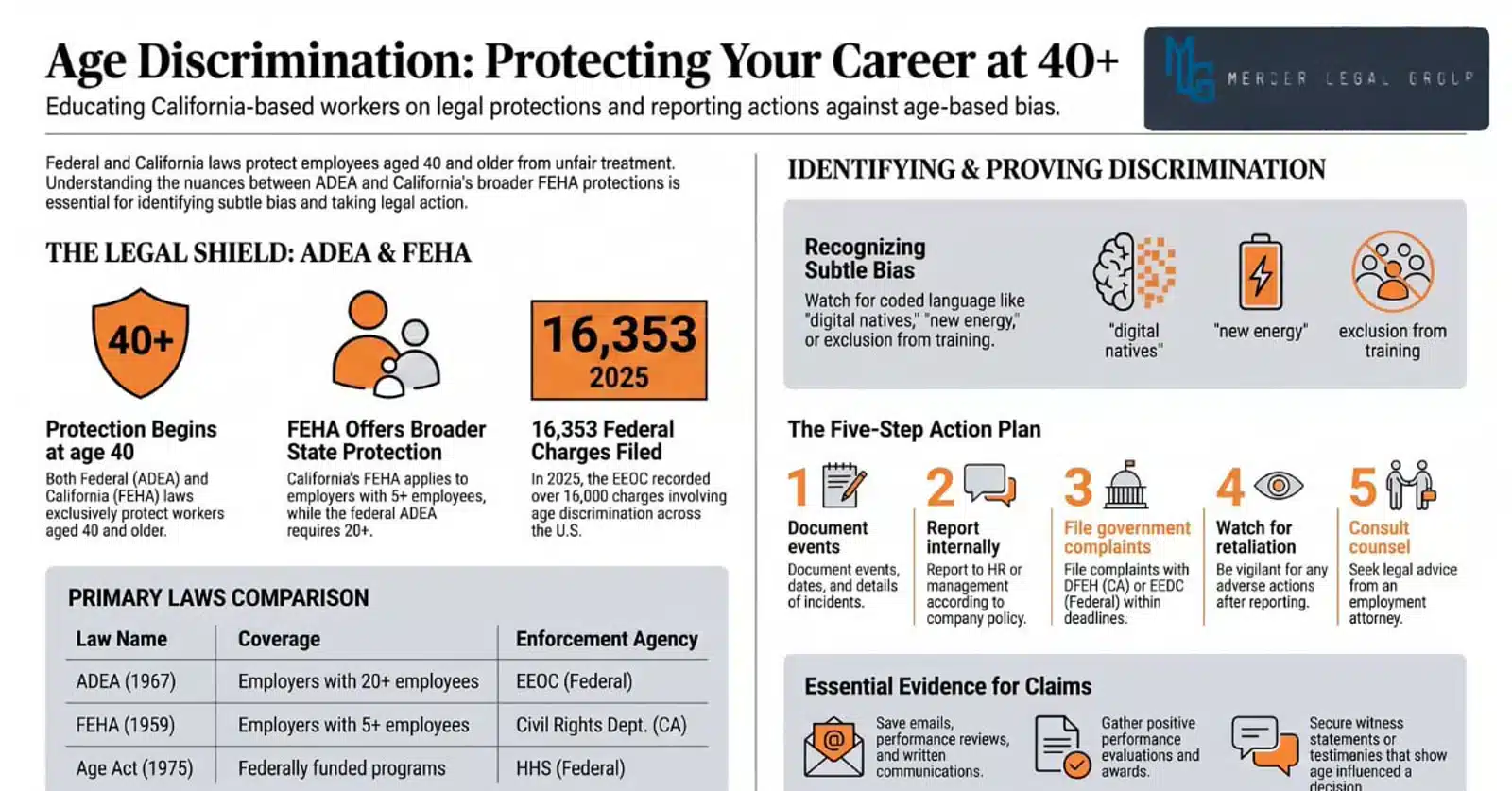
The Age Discrimination in Employment Act of 1967 (ADEA) protects workers who are 40 or older from age-based discrimination in covered employment. It generally applies to decisions involving hiring, termination, promotions, compensation, job assignments, layoffs, and other terms or conditions of employment. Employers cannot make employment decisions based on age stereotypes or assumptions about an older worker’s abilities.
California provides additional protection through the Fair Employment and Housing Act (FEHA). Under California law, employers generally cannot discriminate against an employee or job applicant because of age, and FEHA applies to employers with five or more employees. California’s protections are broader in some respects than federal law, making it important for workers to understand both the state and federal rules that may apply to their situation.
Age discrimination can take different forms in the workplace. For example, an employer may unlawfully refuse to hire someone because they believe the applicant is too old, pass over an older employee for a promotion based on age-related assumptions, reduce an employee’s hours because of their age, or target older workers during a layoff. However, not every workplace decision involving an older employee is automatically illegal. The facts and reason for the decision matter.
California law also protects employees from retaliation for reporting or opposing unlawful age discrimination or participating in a related investigation or proceeding. If you believe an employment decision was influenced by your age, reviewing the circumstances, available evidence, and applicable deadlines can help you understand your options and determine whether you may have a legal claim.
Common Examples of Age Bias in the Workplace

Age discrimination is not always obvious. Common warning signs include being passed over for promotions despite strong qualifications, receiving negative treatment after turning 40, being excluded from important meetings or projects, hearing comments about being “too old” or “near retirement,” receiving less favorable assignments, or being targeted for layoffs while younger employees are retained. A pattern of these actions can be more significant than a single incident, especially when workplace decisions appear connected to an employee’s age.
Proving age discrimination generally requires evidence showing that age played a role in the employer’s decision. This may include emails, text messages, performance reviews, disciplinary records, job postings, termination documents, salary or promotion records, and statements made by supervisors or coworkers. Witness accounts can also help establish what was said or done, particularly when comments about age were made in connection with hiring, promotion, discipline, termination, or other employment decisions.
Age discrimination can be difficult to prove because employers may give legitimate reasons for their decisions, such as performance, restructuring, or business needs. Keep detailed records of relevant events, including dates, conversations, decisions, and the names of witnesses, and preserve documents you are lawfully allowed to keep. If the evidence suggests your age influenced an employment decision, speaking with a California employment lawyer can help you evaluate the facts and understand your legal options.
AI Hiring Bias & Modern Age Discrimination in 2025
California employment laws against employment discrimination have changed to suit modern working reality during the past few years. 2025 represented a major advancement in the application of age-related rights, and many important events have changed the legal environment. Enhanced remote work and digital transformation have sparked age-related issues as older workers are sometimes unfairly seen as less flexible or tech-savvy.
Post-pandemic restructuring and economic changes have resulted in layoffs disproportionately affecting older employees, often under the pretext of performance or cost-saving measures. Court rulings in California and beyond clearly show that age discrimination doesn’t have to be overt to be illegal. Subtle patterns and coded language can still amount to a violation.
What Does the Age Discrimination Act Mean for You in Your Employment?
If you are 40 or older, federal and California laws may protect you from age discrimination at work. The Age Discrimination in Employment Act (ADEA) and California’s Fair Employment and Housing Act (FEHA) generally prohibit covered employers from making employment decisions based on age. These protections can apply to hiring, promotions, pay, job assignments, education and training, layoffs, termination, and other terms of employment.
Age discrimination can appear in different ways. Examples include rejecting a qualified older applicant in favor of a younger candidate because of age, overlooking an older employee for promotions or training, excluding them from important projects, or targeting them during a layoff because of their age. Repeated comments about retirement, being “too old,” or the need for “young blood” may also be relevant evidence when they are connected to an employment decision.
If you believe your age influenced a workplace decision, you do not have to simply accept it. Keep records of relevant comments, decisions, emails, performance reviews, and other evidence, and consider speaking with a California employment lawyer about your rights and potential legal remedies. The specific protections and deadlines that apply can depend on your employer, the circumstances, and whether you have a claim under California or federal law.
Is Subtle Age Bias Still Illegal?

Subtle age bias can be harder to recognize than direct age discrimination, but it may still be unlawful when age influences an employment decision. Comments such as wanting “digital natives,” seeking “new energy,” or looking for a particular “cultural fit” are not automatically illegal on their own. However, if these statements are used to favor younger workers or are part of a broader pattern of hiring, promotion, training, pay, or termination decisions that disadvantage older employees, they may become relevant evidence of age discrimination under California’s FEHA or the federal ADEA.
Other warning signs can include being repeatedly excluded from important meetings, denied training or advancement opportunities, given less desirable assignments, or gradually stripped of responsibilities while younger employees receive better opportunities. If these actions appear connected to your age, document what happened, when it happened, who was involved, and how younger employees were treated in similar circumstances. A California employment lawyer can review the pattern and evidence to determine whether the conduct may support an age discrimination claim.
What Can You Expect From Age Discrimination Lawsuits and Settlements?
There is no standard settlement amount for an age discrimination case in California. The value of a claim depends on factors such as lost wages, the strength of the evidence, the employer’s conduct, the employee’s efforts to find comparable work, and the grounds supporting the claim. Depending on the circumstances, a successful claim may involve back pay, front pay, emotional distress damages, and other available remedies, while some cases may also support attorney’s fees or additional damages under applicable law.
The process can vary significantly from case to case. It may begin with an internal complaint or administrative filing, followed by an investigation, demand for compensation, settlement negotiations, mediation, or a lawsuit. Some cases resolve within months, while more complex disputes can take much longer, particularly when the parties cannot agree on a settlement and the case proceeds through discovery and trial.
For example, an older employee who is passed over for promotion, subjected to age-related comments, and later terminated may have stronger evidence if younger employees with similar qualifications received better opportunities. However, the outcome and potential compensation depend on the specific facts and applicable California and federal laws. Because deadlines can apply to discrimination claims, speaking with a California job discrimination lawyer early can help you understand your potential remedies and next steps.
How to File an Age Discrimination Claim: EEOC and CRD Deadlines
The Age Discrimination in Employment Act of 1967 (ADEA) is the primary federal law protecting workers who are 40 or older from age discrimination in employment. The ADEA generally applies to private employers with 20 or more employees, as well as certain other covered employers.
It applies to covered employers and generally prohibits age-based discrimination in hiring, termination, promotions, compensation, and other employment decisions. The Age Discrimination Act of 1975 is different and it generally prohibits age discrimination in programs or activities receiving federal financial assistance, rather than serving as the main federal workplace age-discrimination law.
In California, workers have additional protections under the Fair Employment and Housing Act (FEHA). FEHA generally applies to employers with five or more employees and prohibits discrimination based on age for employees and job applicants who are 40 or older. California law can provide broader protections and remedies than federal law in some circumstances, including protection against retaliation for opposing unlawful discrimination.
The U.S. Equal Employment Opportunity Commission (EEOC) enforces the ADEA and investigates eligible workplace age-discrimination complaints, while California’s Civil Rights Department (CRD) enforces FEHA.
Age discrimination continues to generate thousands of workplace complaints. In fiscal year 2025, the EEOC recorded 16,353 ADEA charges, including cases in which age discrimination was alleged alongside other forms of discrimination. Federal and state protections can overlap, but the applicable deadlines, procedures, and available remedies may differ, so understanding which laws apply to your situation is important before pursuing a claim.
| Law Name | Year Passed | Key Protections | Age Covered | Enforcement Agency |
|---|---|---|---|---|
| Age Discrimination in Employment Act (ADEA) | 1967 | Prohibits age discrimination in hiring, termination, promotions, compensation, and other employment decisions. | 40 and older | U.S. Equal Employment Opportunity Commission (EEOC) |
| Age Discrimination Act of 1975 | 1975 | Prohibits age discrimination in programs and activities receiving federal financial assistance. | Generally all ages, subject to statutory exceptions | U.S. Department of Health and Human Services (HHS) and other federal agencies |
| California Fair Employment and Housing Act (FEHA) | 1959 | Prohibits age discrimination and retaliation in covered employment and provides additional state-level protections. | 40 and older | California Civil Rights Department (CRD) |
What to Do If You Experience Age Discrimination
If you believe your age has affected how you are treated at work, taking the right steps early can help protect your rights. Here is a practical approach to documenting what happened, reporting discrimination, and exploring your legal options.
Step 1: Document What Happened
Keep a detailed record of discriminatory comments, workplace decisions, dates, witnesses, and how younger employees were treated in similar situations. Save relevant emails, messages, performance reviews, job postings, and other documents you are lawfully allowed to keep.
Step 2: Report the Discrimination
Depending on your circumstances, you may report the conduct through your employer’s HR department or another internal reporting channel. Put your complaint in writing when possible and keep a copy of what you submitted and any response you receive.
Step 3: Consider Filing a Government Complaint
You may be able to file an age discrimination complaint with the EEOC under federal law or the California Civil Rights Department (CRD) under California law. Filing deadlines can be strict, and the applicable limitations period depends on the law and circumstances of your claim. Depending on the circumstances, you may need to take legal action within a specific deadline after filing or receiving an agency determination.
Step 4: Consider Making an Internal Report
Review your employerâs discrimination and complaint policies. A clear written report can establish that the employer received notice and give it an opportunity to respond. Keep the report factual: identify the conduct, relevant dates, the people involved, and why you believe age played a role. Avoid exaggeration or speculation. Retaliation for reporting suspected age discrimination may create a separate legal claim. Retaliation can include termination, demotion, reduced hours, undesirable assignments, exclusion, threats, or intensified scrutiny.
Step 5: Speak With an Employment Lawyer
An employment lawyer can review the evidence, identify which laws may apply, and explain your potential remedies. Getting legal advice early can also help you avoid missing an applicable filing deadline or taking steps that could weaken your claim.
Are You Experiencing Age Discrimination at Work?

The Age Discrimination Act is more than just a notion in 2026. It is a necessary legal structure shielding older employees from unjust treatment. Whether your complaint results in mild bias, direct harassment, or reprisals, you have the right to act.
Your age should not cause you to let yourself be hushed or sidelined. The Age Discrimination Act is on your side, and likewise, the employment lawyers are ready to defend your rights. Speak with a knowledgeable California employment lawyer right now if you have faced age discrimination at work or believe your age is being used against you.
At Mercer Legal Group, our employment attorneys in California represent employees in a wide range of age discrimination matters. Simon Moshkovich has recovered more than $8 million for workers, and our firm is rated 4.9 stars. If you think you were managed out for getting older, contact us for a free review.
Frequently Asked Questions
Age discrimination laws cover employment discrimination based on a person’s age in many workplace decisions. Federal age discrimination regulations and California law provide protections, while certain age distinctions may be lawful in limited circumstances.
At What Age Does Age Discrimination Protection Start?
The federal Age Discrimination in Employment Act (ADEA) protects workers who are 40 or older from employment discrimination based on their age. California’s FEHA also protects workers age 40 and older from age discrimination in covered employment.
What Is Considered Age Discrimination in the Workplace?
Age discrimination can involve hiring, termination, promotion, pay, benefits, or other employment decisions based on his or her age. Ageist language, discriminatory job notices, or an offensive work environment may also be relevant when they are connected to unlawful age-based treatment.
Can I File an Age Discrimination Claim If I Was Laid Off?
Yes, a person may have a claim if their age was a factor in a layoff or other adverse employment decision. Evidence that an employer takes age into account while retaining younger, similarly situated workers may help establish discrimination.
What Evidence Do I Need to Prove Age Discrimination?
Evidence can include age-related comments, job notices, emails, performance records, and witness testimony. Patterns of employment discrimination based on age may also support a claim when the evidence shows that age affected the decision.
What does the Age Discrimination Act cover?
The ADEA helps cover employment discrimination against workers who are 40 or older, including discrimination involving hiring, termination, compensation, and other employment terms. Certain age distinctions may be permitted when age is a bona fide occupational qualification reasonably necessary to the normal operation of a particular business, subject to the statutory requirements and the applicable statutory objective.
What is the Average Payout for Age Discrimination?
There is no standard payout because available remedies depend on the facts, applicable law, and damages suffered by the person bringing the claim. Potential remedies may include back pay, front pay, benefits, reinstatement, or other relief where authorized.
Disclaimer: The information on this page is general legal information about California law and does not constitute legal advice for any specific situation. Reading this page or contacting Mercer Legal Group does not create an attorney-client relationship. California employment laws change over time and may apply differently depending on the specific facts of a case. For advice about your particular situation, consult a qualified California employment lawyer directly. Past results, illustrative examples, and references to typical outcomes do not guarantee similar results in any specific case.