

TL;DR: Yes, in most cases a California employer can require overtime and discipline you for refusing scheduled shifts, but they have to pay you at least time and a half or double time, respect your day of rest and your breaks, and can’t punish you for refusing unsafe work or complaining about pay. California overtime rules count daily hours as well as the 40-hour week, so one 10-hour shift earns overtime pay even in a short week. Both sides need the rules, since employers who do not apply them correctly face penalties and workers who don’t know them leave overtime wages unclaimed.
In 2024, Mercer Legal Group reached a $300,000 pre-litigation settlement for a Los Angeles County employee fired after three months for reporting wage and hour violations. Founding partner Simon Moshkovich practiced at Skadden, Arps, Slate, Meagher & Flom and Latham & Watkins before opening a Woodland Hills firm that represents employees, not employers. Our firm focuses on workers who were fired, demoted, or had hours cut after raising overtime or break complaints, and No fee unless we recover for you; costs and fee terms are explained in the written agreement. If your employer pushed back when you asked about overtime, schedule a free consultation.
Below, we cover how the law works, its exemptions, the limits on mandatory overtime, your rights, the steps to take, and how an attorney helps.
California Overtime Laws Overview
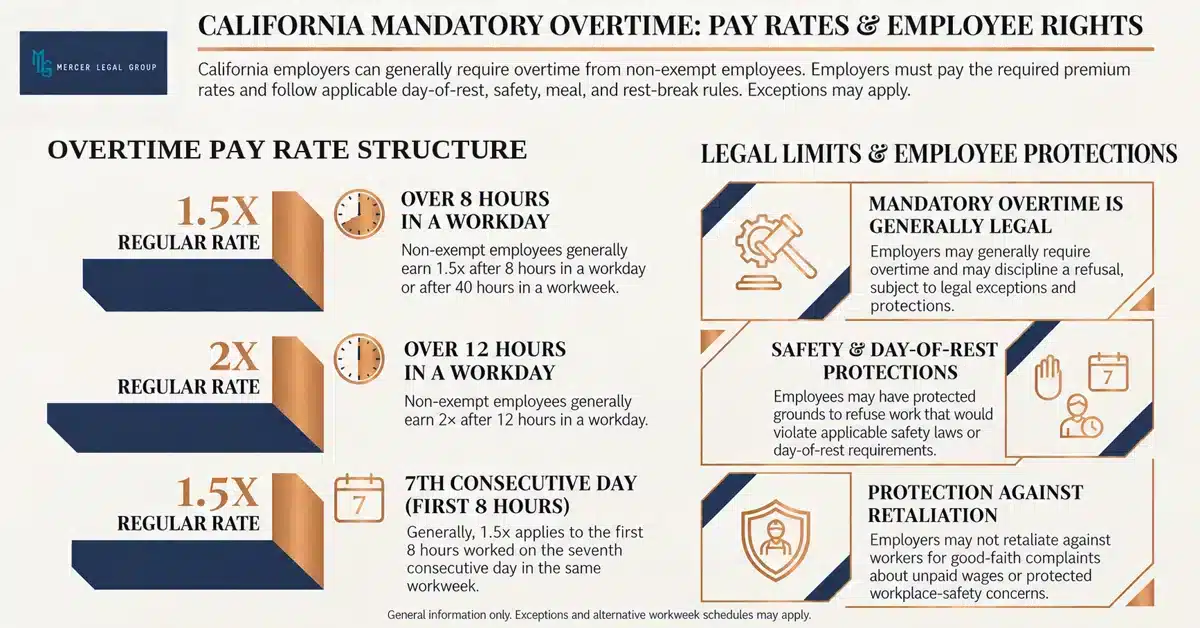
Overtime is work past the daily or weekly limits, paid as a multiple of the employee’s regular rate. Under Labor Code section 510, eight hours is a day’s work, so non-exempt employees earn time and a half for more than eight hours in a workday, more than 40 hours in a workweek, and the first eight hours on the seventh consecutive day in a workweek. Double time applies past 12 hours in a day and past eight hours on that seventh day.
The Labor Commissioner’s overtime FAQ says the regular rate of pay includes hourly earnings, salary, piecework, and commissions. This table shows how those overtime rules apply to most hourly employees.
| Hours worked | Rate owed |
|---|---|
| First eight hours in a workday | Regular rate |
| Over eight, up to 12, in a workday | 1.5x regular rate |
| Over 12 in a workday | 2x regular rate |
| Over 40 hours in a workweek | 1.5x regular rate |
| First eight hours, seventh consecutive day | 1.5x regular rate |
| Over eight hours, seventh consecutive day | 2x regular rate |
The California Labor Code sets the baseline, and Industrial Welfare Commission wage orders, like Wage Order 4 for professional, technical, clerical, and mechanical jobs, add rules on hours and breaks. California Labor Code section 1198 makes it unlawful to employ anyone for longer hours than an order allows. The California Department of Industrial Relations (DIR) enforces these labor laws through the Labor Commissioner’s Office, also called the DLSE.
Federal overtime laws apply too. The Fair Labor Standards Act, 29 U.S.C. section 207, requires time and a half only after 40 hours in a workweek, and the U.S. Department of Labor states there is no limit on the hours employees 16 and older may work in any workweek. Where state law is more generous, the employer must follow it. Its Wage and Hour Division recovered more than $259 million in back wages for 176,957 employees in fiscal year 2025.
The California minimum wage rose from $16.50 to $16.90 an hour on January 1, 2026, the Labor Commissioner’s Office reports, lifting the minimum salary for most exempt employees to $70,304 a year. Under section 515.5, computer professionals must now earn at least $58.85 an hour or $122,573.13 a year to be exempt, per the DIR’s 2026 adjustment. And in 2024, AB 2288 and SB 92 reformed PAGA, limiting claims to violations the employee personally suffered and capping penalties for employers that take reasonable steps to comply.
What Are the Key Provisions and Exceptions in California Overtime Laws?
The overtime pay requirements are firm. Employees who are nonexempt and work for more than eight hours a day or 40 a week must receive overtime pay, and section 1194 lets them recover unpaid overtime whether or not there is any agreement to work for a lesser pay.
Salaried employees aren’t automatically exempt, and many salaried employees entitled to overtime don’t realize it. For them, section 515 sets the regular hourly rate at 1/40th of the weekly salary, which covers only regular hours. In Alvarado v. Dart Container Corp. (2018) 4 Cal.5th 542, a warehouse associate earned a flat $15 bonus for each full weekend shift, and the California Supreme Court held that the bonus must be divided by nonovertime hours worked, which raises the overtime rate.
Exempt employees are the main exception. Executive, administrative, and professional staff qualify only if they spend more than half their time on exempt duties, regularly use independent judgment, and earn at least twice the state minimum wage for full-time work. An alternative workweek approved by two-thirds of affected employees in a secret ballot can also allow 10-hour days without daily overtime, though hours past the schedule still earn it.
Union workers may follow different rules. Section 514 says sections 510 and 511 don’t apply to employees under a valid collective bargaining agreement that covers wages, hours, and working conditions, pays premium pay for all overtime, and sets a regular hourly rate at least 30 percent above the minimum wage. If your union contract doesn’t meet that test, the Labor Code rules apply.
What Are the Mandatory Overtime Legalities in California?
Is mandatory overtime legal in California? Mostly, yes. The Labor Commissioner says an employer may generally dictate work hours and, under most circumstances, discipline an employee up to and including termination for refusing scheduled overtime. That tracks at-will employment under California labor law, section 2922, which means employers can set schedules and end employment for most legal reasons, so requiring employees to stay late for inventory isn’t unlawful by itself.
The obligations come with how an employer requires overtime. Overtime must be paid by the next regular payday after the period the employee works it, and section 226 wage statements must list hours worked and each rate.
Section 512 requires a 30-minute meal period after five hours and a second after 10, workers get paid 10-minute rest breaks for every four hours or major fraction, and a missed break costs one extra hour of pay per workday under section 226.7, per the Labor Commissioner’s meal period guidance. Sections 551 and 552 entitle workers to one day’s rest in seven.
Employers who skip overtime pay face section 558 penalties of $50 per underpaid employee per pay period, then $100 for later violations, and section 203 waiting time penalties run up to 30 days of wages when final pay is willfully withheld. Retaliation for a wage complaint can add a civil penalty of up to $10,000 per employee under section 98.6.
What Protections Do Employees Have Against Mandatory Overtime?
You can’t refuse to work mandatory overtime just because it’s inconvenient, but you can in specific situations. The Labor Commissioner says an employer cannot discipline you for refusing to work the seventh day in a workweek, and Wage Order 4 bars firing or discipline for refusing more than 72 hours in a workweek, except in an emergency. Section 6311 protects workers who refuse work that would violate a safety order and create a real and apparent hazard.
Section 98.6 bars adverse action against an employee who complains about unpaid wages, and if the employer acts within 90 days, the law presumes retaliation unless the employer rebuts it. Section 1102.5 covers reports of legal violations to a supervisor or agency. Disciplinary action, reduced hours, or a negative review can all be factors.
Contracts can set your schedule, but they can’t erase overtime pay, since section 1194 overrides any agreement to work for less. A valid alternative workweek or qualifying union contract can change the rules. If your offer letter calls you “exempt” but your duties or salary don’t meet section 515, that label doesn’t control your overtime pay.

What Are the Employee Rights Regarding Overtime in California?
Your rights start with whether you’re exempt. Many salaried workers aren’t if they earn under $70,304 or fail the duties test, so check whether a salaried employee can get overtime pay in California. Section 1174 also says an employer can’t stop you from keeping a personal record of hours worked.
You have the right to be paid for the hours you have worked, including off-the-clock prep and required meetings, at the correct overtime rates, plus additional compensation for denied breaks. If an employer refuses to pay, state wage laws let you file a wage claim or sue to recover unpaid wages for three years under Code of Civil Procedure section 338 or four under the Unfair Competition Law, Business and Professions Code section 17208. FLSA claims run two years, three if willful, under 29 U.S.C. section 255.
Also, working long hours doesn't suspend your right to a safe workplace. Section 6310 protects employees who complain to Cal/OSHA or their employer about unsafe working conditions, and a 12-hour day with no rest breaks means premium pay on top of overtime compensation.

What Are the Steps to Take if You Are Forced to Work Overtime by an Employer?
Working extra hours without getting proper compensation is really frustrating. You have rights that should not be ignored; there are things you can do to stand up for yourself and ensure you get what you're due.
-
Step 1: Track Every Hour You Work
Log start times, end times, and meal breaks daily. A personal log is important if the employer's records are wrong.
-
Step 2: Keep Your Pay Stubs and Schedules
Save wage statements, texts, and schedules to a personal device. Compare the overtime hours worked on each stub against your log.
-
Step 3: Raise the Issue in Writing
Email your supervisor or HR and list the hours that you believe were unpaid. Sending this complaint in writing is protected under sections 98.6 and 1102.5 and will create a dated record.
-
Step 4: File a Wage Claim With the Labor Commissioner
DIR accepts wage claims via email, mailing address, or in person. Generally claims are accepted within three years for overtime work. You fill out an initial report or claim form and submit relevant records with them.
-
Step 5: Report Retaliation Right Away
If you are punished for complaining, file a retaliation complaint with the Labor Commissioner. Most must be filed within one year of the retaliatory act.
-
Step 6: Seek Legal Counsel for Persistent Issues
Talk to an employment lawyer if the violations keep happening or if your boss punishes you. They can help you figure out if filing a complaint with some agency, suing someone, or sending a PAGA notice is appropriate.

How Can an Attorney Help Protect Your Overtime Rights?
An attorney will look at your facts and compare them to the laws in order to determine if you are truly exempt from certain rules, how your hourly rate should be determined, what penalties may apply and whether any response from your employer is retaliatory. This review usually shows that bonuses are not included in calculating regular pay or that work on Saturdays gets paid at normal rates rather than premium ones. An attorney might also ask to see payroll records and sue for back pay, penalties and legal fees.
Mercer Legal Group focuses on employees punished after raising overtime or break complaints, building cases from the timeline, time records, and how the employer treated workers who didn’t complain. No fee unless we recover for you; costs and fee terms are explained in the written agreement. Learn how overtime retaliation claims work, or talk with a retaliation lawyer about your job.
Practical Tips for Employers and Employees
Employers should schedule shifts in advance and leave room for meal breaks. They also need to track daily overtime along with totals for the week and include bonuses as part of the regular pay rate. Employers should review exemptions every January because salary floors rise along with minimum wage. If employers abide by the rest day rule, they inform employees about that day off and stay impartial.
Train supervisors well on labor and wage laws because new problems arise most often when supervisors ask workers to do work without being clocked out. Supervisors should pay overtime that has not been approved and should take complaints about wages seriously. They also need to keep time records for at least three years.
For employees, good records really do most of the work. Record your times for work, breaks, and any messages you send late at night as well. Check each record, and if there is anything that is inconsistent, request written corrections by a certain deadline.
Have You Been Forced to Work Overtime by Your Employer in California?
So, can a California employer force you to work overtime? Usually, yes, but it must pay time and a half after eight hours a day or 40 a week, double time after 12 hours or eight on the seventh consecutive day, and it can't punish you for refusing a seventh day, unsafe work, or complaining about pay. Most wage claims must be filed within three years. If your employer cut your hours or fired you after you questioned your overtime, get legal advice before deadlines pass.
Were you fired, demoted, or had your hours cut after asking about overtime? In 2024, Mercer Legal Group secured a $300,000 pre-litigation settlement for a Los Angeles County worker fired just three months after reporting wage violations. Founding partner Simon Moshkovich began his career at Skadden and Latham & Watkins, and now his Woodland Hills firm fights only for employees. No fee unless we recover for you; costs and fee terms are explained in the written agreement, so schedule your free consultation today.
FAQs on Employee Overtime Rights
Mandatory overtime feels different once you know exactly what the law requires and where the limits are. Here's the question California employees ask most.
What Are the California Laws Regarding Overtime Pay?
California Labor Code section 510 generally requires non-exempt employees to receive 1.5 times their regular rate after eight hours in a workday, after 40 hours in a workweek, and for the first eight hours worked on the seventh consecutive day in the same workweek. Double time generally applies after 12 hours in a workday and after eight hours on that seventh day. Exemptions, valid alternative workweek schedules, certain collective bargaining agreements, and occupation-specific wage orders can change how these rules apply. Employers must also include qualifying nondiscretionary compensation when calculating the regular rate.
Can I Refuse to Work Overtime in California?
A California employer may generally require overtime and may discipline an employee who refuses a lawful schedule. The answer can change when day-of-rest protections, a qualifying safety issue, a collective bargaining agreement, or an occupation-specific wage order applies. Workers covered by IWC Wage Order No. 4 generally may not be disciplined for refusing to work more than 72 hours in a workweek, except during an emergency defined by that order. Because the rules depend on the employee’s classification, industry, schedule, and reason for refusing, workers should document the request and seek advice before assuming they can decline the shift.
How Many Hours Can a California Employer Require You to Work?
California does not impose one universal weekly cap for every adult employee. An employer may often schedule long days or workweeks, provided it pays covered non-exempt employees all required overtime and follows meal-period, rest-break, day-of-rest, and safety rules. Additional limits may come from an Industrial Welfare Commission wage order, a collective bargaining agreement, or laws governing a particular occupation. For example, Wage Order No. 4 protects covered workers who refuse more than 72 hours in a workweek, except during a defined emergency. The lawful limit therefore depends on the worker’s classification, industry, schedule, and applicable agreement.
Can a California Employer Require Employees to Work Overtime?
Yes, in most situations a California employer can require employees to work overtime and can discipline a refusal to work a lawful scheduled shift. That authority does not excuse the employer from paying every overtime premium owed to a covered non-exempt employee. The employer must also provide required meal and rest periods, comply with applicable day-of-rest and workplace-safety rules, and honor any limits imposed by a wage order or collective bargaining agreement. It may not retaliate against an employee for making a good-faith complaint about unpaid wages, unsafe conditions, or another protected legal right. Specific exceptions depend on the employee and industry.
Are California Employers Required to Pay Overtime?
Yes. California employers generally must pay non-exempt employees the applicable overtime premium, and an employee cannot waive that right by agreement. Time-and-a-half and double-time rules can be triggered by daily hours, weekly hours, and work on a seventh consecutive day in the same workweek. Employers must use the employee’s regular rate, which may include more than the hourly wage. Different rules may apply to properly classified exempt employees, valid alternative workweek schedules, certain unionized employees, and workers covered by specific statutory exceptions or wage orders. Misclassification or off-the-clock work does not eliminate the employer’s obligation to pay wages that are legally due.
Disclaimer: This article is for informational purposes only and is not legal advice. Reading it or contacting Mercer Legal Group does not create an attorney-client relationship. Attorney Advertising. Prior results do not guarantee a similar result or predict the outcome of any future case. Mercer Legal Group, 21031 Ventura Blvd., Suite 103, Woodland Hills, CA 91364. Responsible attorney: Simon Moshkovich, California State Bar #323584.