Evidence from witnesses can be useful. Even if there is not direct evidence such as emails there can be a range of evidence to prove your decision was based on your sex/gender.
If you believe you have been treated differently due to your sex/gender/pregnancy/gender identity/gender expression, our gender discrimination lawyers can help. Give us a call today for a free initial consultation.
For Legal Advertising Purposes Only
What is Evidence for Gender Discrimination?
Evidence of gender discrimination is anything that shows your employer made a decision about your job because of your sex or gender. You are protected from gender discrimination under Federal Law (Title VII of the Civil Rights Act of 1964). Under California law you are protected from discrimination based on your sex/gender/pregnancy/gender identity/gender expression under the Fair Employment and Housing Act (FEHA).
Being treated unfairly at work doesn’t necessarily mean unlawful discrimination has occurred. You will need to prove that the incident was due to your protected characteristic and that it has usually affected your employment (being dismissed, demoted, underpaid, not promoted, disciplined and loss of responsibility).
Direct Evidence
Evidence showing clearly decisions were made based on your gender. This can be emails stating males should be promoted to leadership positions or someone involved in the decision making process stating women with young children are not committed.
Circumstantial Evidence
Evidence showing comparisons. You are very competent but have not been promoted while others at the same competency level have. Your manager rates your work highly, yet you are passed over for the promotion that usually follows those ratings. The reason you have not been promoted doesn’t fit with your background. This evidence may seem small however if there are various instances and everything points to the same result, you may have a pattern.
Make sure your comparisons are fair. A good witness would be someone in the same role as you, with the same experience, competency, manager and background. Sometimes there can be statistical evidence to show there is a bigger issue. This will depend on the accuracy of the data.

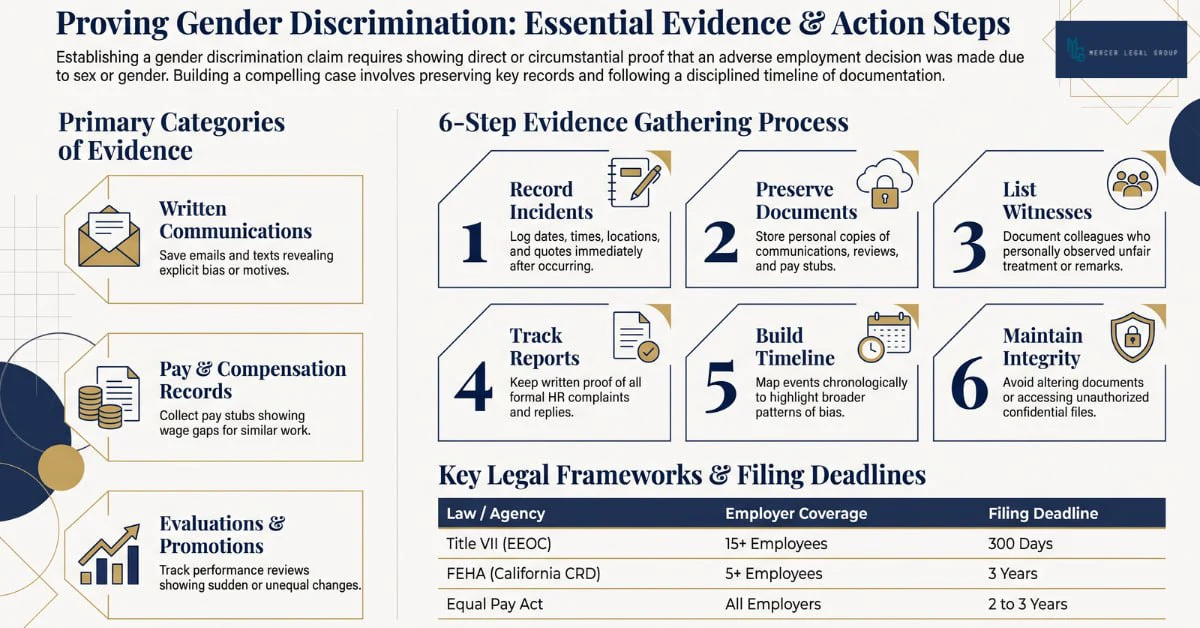
There are 9 types of evidence.
The best claims will have various pieces of evidence. Below are examples of evidence you may have.
1. Emails/Texts
Written evidence can be very useful to prove what your boss said and when. Try to save any evidence relating to your employment, promotions, pay rises, tasks, discipline, vacation and termination. Even if there are not obvious sexist comments, they can show who was involved in the decision making process, that the reason for your decision has changed over time or that the stated reason is not the real one.
Try to save the original evidence. Take note of the date, who it was sent from to whom and the full conversation. Do not edit any screenshots. If you are unsure if you can save any evidence from work contact a lawyer.
2. Witness Statements
A good witness would be someone from work who heard something during the promotion meeting or saw behavior change between 2 people. First hand evidence is much better than just rumor. The best witness will only state what they saw, who was there and what was said. General feelings about the company will not be useful.
Sometimes ex employees or HR will know about similar complaints or unfair policies. Don’t rely on people to give statements.
3. Pay Stubs/Pay Evidence
This will show what you have been paid. If you can compare with others in very similar roles it will be more useful. You can discuss salaries in California and see what others are getting. Your boss cannot retaliate against you. They don’t have to tell you how much everyone is getting. Current employees can ask what the pay scale is for their role (Labor Code section 432.3). There may not be discrimination, it could be based on seniority, educational background, training, experience, output or other legal reasons.
4. Performance Reviews/Employment
This will show how you were performing before and after the decision was made. If you had a good performance review for a few years and then a bad one this can be relevant. This is especially true if the change came around the time you were passed over for a promotion, made a complaint, became pregnant or got a new boss.
Try to save any written feedback, discipline, attendance, awards, sales and completed projects. This can show reasons for your performance.
5. Promotions/Employment
Job adverts, job descriptions, application forms, interview notes, selection criteria and promotion details can show what your employer said they wanted and what they based their decision on. Sometimes it will show that halfway through they changed the criteria, you didn’t meet the criteria or they didn’t follow normal processes.
While there may have been a legal reason for promoting someone, if males are always chosen over equally or more qualified females this can change things. Especially if the same managers are using the same criteria.

6. Company Policy/Employee Handbook
This will show what your employer has in place. What they expect from their employees regarding recruitment, vacation, promotions, discipline, pay, dress code and complaints. How they have applied this will give more detail. If females are being written up for things males do without any adverse action this can show they have been treated unfairly.
Ensure you have the most up to date handbook/policy. If it has been rewritten it may not be what employees/managers should be following.
7. Discriminatory Comments
Sexual, leadership, parental, and pregnancy-related comments can all be great evidence. Individual comments can be useful however looking for similar comments in the correct time frame can be very useful.
8. Complaint to HR
This can be great evidence to show you made a complaint. Take note of everything you complained about. Confirmations, Invitations to meetings, Meeting Notes, Follow up emails and Request for information.
This is not strong evidence however can show you made a complaint.
9. Adverse Action
Evidence of adverse action. Once you have made a complaint and/or protected act look for any adverse action that has occurred regarding your role. Being dismissed/demoted, Underpaid, Not promoted, Fewer hours, Not invited to meetings, Threatened, More monitored and Bad review. The best evidence you can get is if you can show adverse action occurred shortly after you made a complaint. This will likely require more evidence such as emails, inconsistencies and unfair treatment.
How can I prove Gender Discrimination with Circumstantial Evidence?
Most employers will not have any written evidence of bias and circumstantial evidence can be used to prove gender was a factor.
Comparisons
Look for any employees of the opposite gender doing similar roles. They should have the same decision makers, similar experience and performance. The closer they are to the employee the better.
Your boss may also have given you conflicting reasons for treating you differently. For example, they may say you lack leadership experience and technical skills, even though your performance reviews and project history show otherwise. That mismatch can suggest the stated reason is not the real one.
You may have been treated differently from male colleagues in interviews, promotion decisions or discipline. Or you may have received a bad review soon after you raised sexist comments, unequal pay or other concerns with HR.
You are protected in California from Gender Discrimination.
You may be protected under state and federal law. Below are some of the laws that can apply to you. Depending on your situation there may be specific laws that apply. There are time limits.
| Protection/Law | Protection |
|---|---|
| California FEHA | Protects employees from discrimination based on sex/gender/pregnancy/gender identity/gender expression and retaliation. Must have 5+ employees. |
| Title VII | Protects employees from discrimination based on sex/race/color/religion/national origin. Must have 15+ employees. |
| Pregnancy Discrimination Act | Clarifies pregnancy, childbirth and related medical conditions fall under sex discrimination (Title VII). |
| California Equal Pay Act | Prevents employers from paying employees of a different sex/race/ethnicity less for substantially the same work unless there is a legal reason. |
| Federal Equal Pay Act | Employees must be paid the same as the opposite sex for substantially the same work. |
California Civil Rights Department/EEOC
The FEHA is enforced by the California Civil Rights Department (CRD). Usually you have 3 years from the date of discrimination to make a complaint to the CRD. Federal laws are enforced by the Equal Employment Opportunity Commission (EEOC). Title VII usually has a 300 day time limit to make a charge.
Depending on your claim you will have different time limits. Usually the California Equal Pay Act has a 2 year time limit (or 3 years if willful). For further information please see Section 1197.5 of the Labor Code. In some cases you must receive a right-to-sue letter before you can file a lawsuit. It is always best to contact an agency/lawyer as soon as possible, especially before you sue your employer.
How to gather and save evidence

- Write down each incident: when and where it happened, who was involved, what was said and who saw it.
- Keep copies of the original records listed above.
- List your witnesses with their role, contact details and what they saw.
- If you complain to your manager or HR, do it in writing and keep any replies or meeting notes.
- Build one timeline of the decisions, complaints and how your employer responded.
- Do not tamper with documents, create evidence or access confidential files. If you are unsure whether you can keep a document, ask a lawyer.
What should I do if I face Adverse Action?
Under federal and California law your employer should not retaliate against you for opposing discrimination, making genuine complaints or participating in an investigation. Depending on your situation you may have a standalone claim. Take note of any protected acts. When you made the complaint, who you complained to, how you complained and what changes have occurred. Save any evidence of the changes. Compare how you have been treated compared to others in similar roles.
While a timeline can be useful when making a claim for retaliation you will generally want to show protected activity, material adverse action and a link. If you were dismissed you may have a claim for wrongful termination.
When should I contact a Gender Discrimination Lawyer?
If you feel your gender has affected your promotions, pay decisions, discipline, tasks, demotions and termination. Or if you regularly received sexist comments, had an HR complaint ignored, were pressured into signing a severance agreement or faced any type of adverse action it is worth contacting a lawyer.
They can review your evidence, compare how you are being treated compared to your colleagues, advise you on what laws and time limits apply to your situation and advise you on how to save your evidence without breaching any workplace policies/confidentiality. It is best to contact a lawyer as soon as possible to save your evidence.
Do I need a Gender Discrimination Lawyer?
If you have lots of evidence and are unsure if you have a claim we can help. We represent employees in Gender Discrimination, Pregnancy Discrimination, Unequal Pay, Sexual Harassment, Retaliation and Wrongful Termination claims. Contact us today for a free initial meeting.
FAQs
What is the best evidence?
While having direct evidence from whoever made the decision can be useful most claims won’t have this. If you can show evidence such as emails, witness statements, pay stubs, performance performance reviews, comparisons and a good timeline you can prove discrimination.
Can I make a claim without any witnesses?
Witnesses help, but they are not required. Written records, performance reviews, pay records and comparisons with similar coworkers can support a claim on their own.
How can I prove women were paid less?
Make sure you have evidence of your pay stubs and what work you have done. In California you can ask your colleagues what the pay scales are for your role. The pay difference could be legal as they are doing different work, more senior, more educated, trained, experienced or output.
Can I use emails/texts?
Yes. This can provide evidence of any discriminatory comments/stereotypes. This can help identify who made the decisions and any issues with their reasoning. Try to obtain the full conversation and metadata.
What if my employer deletes evidence?
If your employer deletes relevant evidence, what matters is what was deleted, when, and whether it had a duty to keep it. Contact a lawyer as soon as possible. Do not access confidential files or systems you are not authorized to use.
How long will my Gender Discrimination Claim take in California?
It depends on the route you take. You generally have 3 years to file with the California Civil Rights Department (CRD) and 300 days to file a charge with the EEOC. The EEOC says its investigations take about 10 months on average, while cases that settle through its mediation program usually resolve in less than 3 months. You can also ask the CRD for an immediate right-to-sue notice; you then generally have 1 year to file a lawsuit (Government Code section 12965). A lawsuit can take a year or more, depending on discovery, court dates and whether the case settles.
Can I make a claim if I wasn’t terminated?
Possibly. If you weren’t promoted, fairly paid, demoted, disciplined, had less responsibility or faced any adverse action in your employment you may be able to make a claim. It is important to have evidence this is specifically due to your gender.
Note: This article is general information only and should not be taken as legal advice. By contacting us no attorney-client relationship will be formed. Evidence and time limits may vary depending on your situation, employer and law. Please contact an attorney licensed to practice in California.