Legal disclaimer: This article is for general informational purposes only. It is not legal advice and does not create an attorney-client relationship. Deadlines, eligibility, and available remedies depend on the facts and applicable law. Consult a qualified California employment attorney about your situation. Past results do not guarantee a similar outcome.
If you have been harassed at work for reason of Protected Characteristics (Race, Sex, Religion or Disability) under the California Fair Employment and Housing Act you may have grounds to make a claim. Our Founding Member Simon Moshkovich and Employment Team can advise you on which laws may have been breached.
We represent Employees in California and we can offer a Free Consultation.
In this article we will give you some useful information on what constitutes a Hostile Work Environment, how to keep evidence and what to do.
Hostile Work Environment in California
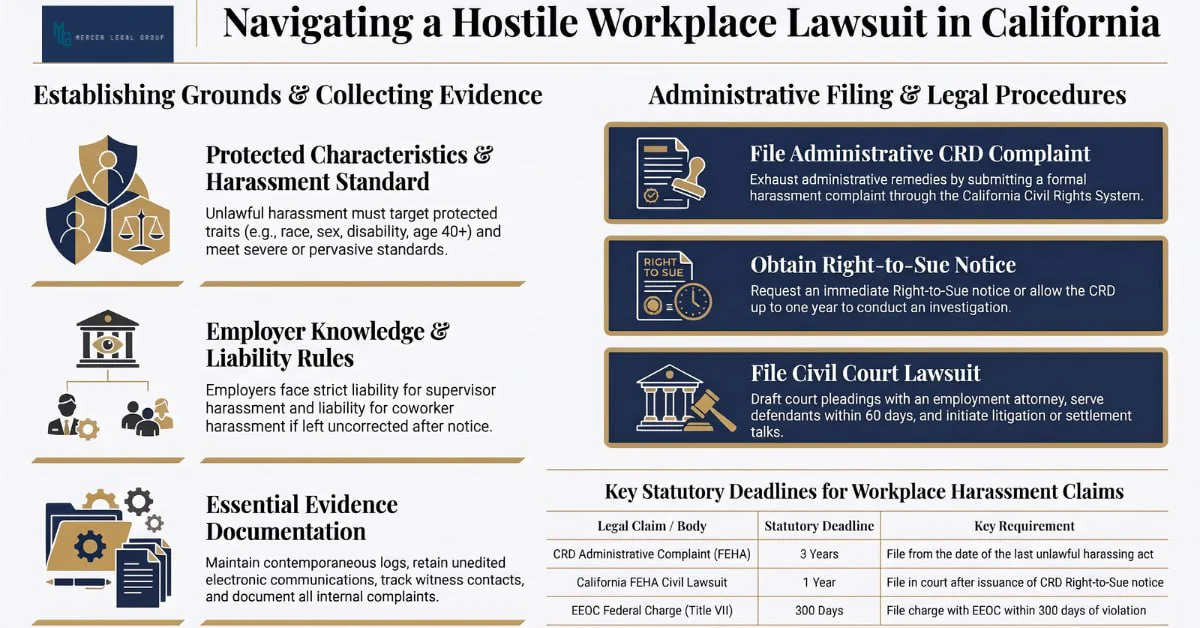
If you have regularly been harassed (or severely harassed) due to being a member of a Protected Group under the FEHA in California you may have a Hostile Work Environment. You are protected against harassment for reasons of Race, Color, National Origin, Ancestry, Sex, Sexual Orientation, Gender Identity, Religion, Disability, Age (40+) and Marital Status. You are also protected if they believe you are a member of any of these.
Generally if you have been severely harassed or regularly harassed, you will have a claim. However, California offers additional protections to employees. So if you have been harassed once and it has caused unreasonable disruption or you feel like you have been harassed, intimidated or offended you may have a claim. (Government Code § 12923)
A Hostile Work Environment may include racist comments, regularly feeling offended by jokes/comments about your religion/disability, unwelcome sexual comments, touching or sexual favors/threats from certain protected groups. It can include sexual harassment but can be a more general issue.
Sometimes it can be very subtle and you may feel like you are being excluded, embarrassed or belittled for your gender identity, age, culture or protected characteristic.
Not all situations will be illegal. If there has been a personality clash and harsh comments have been made, this will not be a Hostile Work Environment. Your manager can criticize your work, give you work and enforce policies, that is perfectly fine. As long as the unwelcome actions were for the reason that you were a member of a protected characteristic and were severe/regular.
If your employer knew or should have known about the harassment from other employees/non-employees and didn’t take the correct and immediate action, they may be liable. (Government Code §12940(j)) If you are finding your work environment unpleasant we would advise keeping evidence.
Protection from Hostile Work Environment in California
The main law protecting employees from discrimination, harassment and retaliation is the FEHA. This protects you from being harassed for reasons of Race, Color, National Origin, Ancestry, Religion, Sex, Gender, Gender Identity, Gender Expression, Sexual Orientation, Disability, Age (40+), Marital Status, Reproductive Health Decisions, Military/Veteran status and other protected characteristics.
Generally harassment laws will apply to businesses with 5+ employees. However in California you will be protected from harassment in the workplace even if your employer only has 1 regular employee. Employees and job seekers are protected. Unpaid Interns, Volunteers and Contractors are protected. You will also be protected from retaliation for making a complaint, opposing unlawful activity and being involved in investigations/proceedings.
Under Federal Law you will be protected from discrimination and harassment for reasons of Race, Color, Religion, Sex or National Origin. (Title VII of the Civil Rights Act of 1964) This will generally apply to businesses with 15+ employees. Employees who have been discriminated and harassed for reason of their disability will be protected under the Americans with Disabilities Act (ADA). Employees aged 40+ will be protected from age discrimination. (Age Discrimination in Employment Act (ADEA))
Employers should take responsibility for preventing and dealing with harassment. All businesses with 5+ employees in California must have Sexual Harassment Prevention Training every 2 Years. Supervisors must complete 2 Hours and other employees 1 Hour. Employers should try to investigate any allegations of harassment and take corrective action if the facts back up your claim.
The FEHA will be enforced by the California Civil Rights Department. Title VII and other Federal Employment Laws will be enforced by the EEOC. They will work together however you can make individual claims. There are differences between the two claims and we would advise knowing which to use.
Claiming a Hostile Workplace in California
Generally you can’t claim in Court under the FEHA. You will have to make a claim with the CRD and obtain a Right to Sue Notice. Firstly we will want to know if what happened falls under potentially unlawful harassment. We would advise keeping any evidence and a note of what your Boss has done.
1. Is it Potentially Unlawful Harassment?
If you have regularly been commented on for your religion, been the subject of unwanted sexual advances or intimidated for your disability you have a stronger claim. If it was bullying and not for a protected trait you may have serious issues however it wouldn’t be a breach of the FEHA.
How often was this happening? Was it severe? Where was this happening? How was the environment? Did you feel threatened or embarrassed? Did it affect your performance? Was it from a Supervisor? Has it continued after a complaint? Under California Law you can make a claim for 1 severe incident. Don’t disregard this as it was a one off.
Have there been any actions around your role? Have you been fired/demotion? Any changes to your hours? This can help with claims such as discrimination, retaliation or wrongful termination.
2. Keep Evidence
We would advise keeping evidence of any incidents. When did this happen? What time? Where? Who? What was said? (Best you can) Who saw this? Having some evidence will help identify when it happened.

Ensure you have a copy of any evidence. This can include; Emails, Texts, Work Messages, Photos, Performance Reviews, Disciplinary Letters and any evidence you should have. Don’t alter any original evidence. If you have made a complaint keep a copy of your complaint and any follow up. Keep any meeting notes and what your Boss said.
Don’t look at any evidence you shouldn’t. Don’t log onto any accounts. Be careful when keeping evidence. Generally you will need permission from those involved in a confidential conversation. (California Penal Code §632) Speak to a lawyer on how to gather evidence without causing any further legal issues.
3. Internal Complaint
By making an internal complaint you are letting your employer know. They can investigate and take action. Your anti-harassment policy should tell you who you can make a complaint to. This could be HR, Supervisor, Compliance Officer or another Manager. If the harasser is on the list make a complaint to someone else.
Generally you won’t need to make an internal complaint in California however it can be useful to have it in writing. This can be very useful if you are making a claim against a colleague for harassment. Keep evidence of what happened, when, who, who saw this and any evidence. Keep a copy.
How was the investigation carried out? Have any corrective actions been taken? Has it moved forward? Has it got worse recently? If you have been demoted, paid less, excluded or fired for a harassment complaint this can help with a retaliation claim.
4. California Civil Rights Department Complaint
Generally you will have to make an administrative claim with the CRD before making a private claim under the FEHA. This is known as exhausting administrative remedies. Firstly create an account on the California Civil Rights System. Click File a Complaint and fill out your intake.
You will need to provide some basic information. Personal Information, Contact Information, Employment Information, Perpetrator Information, Harassment and When. You will need to provide evidence. Once you have submitted this to the CRD they will decide whether they will formally accept your claim. If they will they may ask for further evidence, talk to witnesses and offer mediation/solutions.
5. Obtain a Right-to-Sue Notice
Generally you will need a Right to Sue Notice to make a private claim. You can ask them to investigate or ask for a Right to Sue Notice. If you ask for a Right to Sue Notice they won’t investigate. If you wish to go through the whole process with the agency they may want to investigate to see if there is any evidence and understand what has happened. This will depend on how much evidence you have.
6. File the Lawsuit and Serve the Defendants

Once you have your notice you can make a civil claim. You will need to provide information on who was involved, what happened, what you want to claim for and what remedy you want. You may want to claim for;
Hostile Work Environment Harassment, Sexual Harassment, Retaliation, Discrimination, Failure to Prevent Harassment, Wrongful Termination.
You will need to think about who you want to claim against. Individuals can be liable for harassment under the FEHA however generally not discrimination & retaliation. Your employment lawyer will go through your claims and evidence.
Once you have made your claims you will need to serve your defendants. This is generally done under the California Rules of Court Rule 3.110. Proof of Service must be submitted within 60 days of making your claim (unless otherwise stated).
Time Limits
This will depend on the relevant law. Generally you have 3 years to make an administrative claim with the CRD under the FEHA rules from the last illegal incident. Once you have received your Right to Sue notice from the CRD you will have a new time frame. Federal claims will have different time frames.
| Requirements | Time | Description |
|---|---|---|
| CRD Admin Claim (FEHA) | 3 Years | You have 3 years to report your intake from the last alleged illegal incident. This is very important if you have had multiple incidents of harassment. |
| California Claim (FEHA) | 1 Year | You have 1 year from receiving your Notice of Right to Sue. |
| EEOC Federal Charge | Generally 180-300 Days | You will generally have 180-300 days as there is an agency enforcing claims of a similar nature. |
| Federal Title VII / ADA Claim | 90 Days | You have 90 days from receiving your Notice of Right to Sue from the EEOC. |
The CRD have 2 time frames. 3 years to make a claim and 1 year to go to court. Internal harassment claims won’t affect this. In California you have 300 days to make a claim to the EEOC. If you have had multiple incidents the EEOC will use the last date. Generally you have 90 days to make a claim under Title VII / ADA.
Time frames can be confusing. There can be a long time between incidents. There can be retaliation claims, multiple statutes and admin claims. Don’t use this table to work out your final deadline. Most importantly get a lawyer to look over your time frames and claims.
Evidence for a Hostile Work Environment Claim
We would like to have strong evidence to prove what has happened, why it was for a protected characteristic and what the employer knew/ did. There won’t be 1 piece of evidence to prove your claim but having clear evidence to link things can help.
| Evidence | Proves | Examples |
|---|---|---|
| Logs | What happened, how often and how severe. | When, Where, What was said, Who was there. |
| Written Evidence (Emails, Texts, Work Chat) | What was said, by who and how often. | Offensive/Discriminatory Comments, Unwanted Messages, Threats. |
| Witnesses | Independent Evidence. | Employees from work who have seen the behavior, heard comments and/or experienced the same. |
| Investigation HR Complaint | When the employer became aware and what action was taken. | Complaints, HR Emails, Meeting Notes, Findings, Actions. |
| Employment Evidence | How it affected your employment and what action was taken. | Reviews, Write Ups, Demotions, Schedule changes, Pay Stubs, Termination. |
| Health/Damages | How it affected you. | Medical costs, Therapy, Time Off, Loss of Income. |
Ideally you will have evidence to link everything. If you have logs of comments being said, a message saying this has happened, someone who can remember hearing about this and an email from HR saying they became aware this would be ideal. Don’t lose any evidence you have. Don’t make up any evidence and don’t cause any further issues.
What Can I Claim?
Depending on your claims, evidence and impact you may be entitled to compensation for loss of income, future loss of income, emotional distress, medical costs and legal costs. In some cases you may be entitled to punitive damages.
You may be entitled to back/front pay for loss of benefits/income due to illegal activities/incidents such as being fired/demotion. You may be entitled to emotional Distress for the impact on your mental and emotional wellbeing. If you have evidence to support this claim you may be entitled to the cost of treatment.
You won’t be entitled to punitive damages in all cases. There needs to be clear and compelling evidence of oppression, fraud or malice. (California Civil Code §3294) If the defendant is a company there are additional rules.
No responsible lawyer will be able to tell you how much your claim is worth based on a brief description. No lawyer should guarantee an outcome. How severe the damages are will depend on how much evidence there is to prove damage, your previous employment history, how severe and long the misconduct was, what the employer did and medical evidence.
What Happens Once I Have Made My Claims?
Once you have made your claims and served them to your employer they may agree, disagree or defend some of your claims. Time frames will be set and motions may be made.
Discovery will be made. Both parties will provide relevant documents. Written questions will be answered, requests for admissions and evidence will be provided under oath. If you are making a harassment claim you may be asked to provide work communication, personnel evidence and investigation evidence. You may also be asked to provide policy, training and employee/manager evidence.
At any point you can ask for a resolution. An independent third party will help both parties understand the risks and reach a resolution. You aren’t obliged to accept any offers. If no resolution can be reached a Judge/Jury may decide on the disputed facts and damages.
How Long Will My Claim Take?
This will depend on how many claims/witnesses there are, how much evidence there is, how busy the court is, how many motions there are and if there is a settlement.
When should I contact a Hostile Work Environment lawyer in California?

If you are regularly being harassed, your management aren’t taking your complaint seriously, there is retaliation, you are thinking of quitting or there is a deadline with an agency you should contact a lawyer. The sooner you contact a lawyer the better you can protect your evidence and avoid any mistakes. You aren’t obliged to make a claim.
Many employment lawyers including Mercer Legal Group can offer cases on a contingency basis if you may be eligible. Costs and legal costs should be clearly outlined in an agreement. If you have a potential Hostile Work Environment claim please contact us for a Free Case Review.
FAQ's
Can I sue my employer for Hostile Work Environment in California?
Possibly. If you have been unlawfully harassed for reason of a protected trait you may be able to make a claim. Generally you will have to make a complaint with the CRD and obtain a Right to Sue Notice to make a private claim under the FEHA.
Should I report the harassment?
Generally you aren’t obliged to make an internal complaint however it can be beneficial.
Can I make a claim while employed?
If your situation fits the legal criteria you can make a Hostile Work Environment claim while employed. Ensure you keep all your evidence and be aware of any time frames. We would advise getting some guidance.
Can I sue once I quit?
Not necessarily. If a reasonable person in your situation would feel they had no choice but to leave their job it may be justified to make a claim for constructive discharge. The circumstances are very important so we would advise speaking to a lawyer before quitting.
What is the difference between bullying and Hostile Work Environment?
Behaviors such as intimidation, embarrassment and hostility don’t necessarily breach employment laws. Generally a Hostile Work Environment you could legally claim for would be unwanted behavior relating to something that is protected by law. It would also need to fit certain criteria.
Can I sue if HR aren’t doing anything?
If your employer knew or should have known about the unlawful harassment and didn’t take the correct corrective action you may have a claim. Keep copies of any written complaints and correspondence. Keep evidence if the behavior continues.
How much is my Hostile Work Environment Claim Worth?
There is no set amount. How much your claim is worth will depend on how much income you have lost due to the incident, how much mental anguish you have suffered, how much medical costs you have incurred, how severe and long the behavior was, what your boss did and how much evidence you have. In some cases you may be entitled to punitive damages and legal costs. No one can guarantee an outcome.
Attorney Advertising. Published by Mercer Legal Group, Suite 103, Woodland Hills CA 91364, 21031 Ventura Blvd. Responsible Attorney: Simon Moshkovich State Bar of California No.: 323584.