Examples of race discrimination in the workplace include: missing out on promotions, receiving lower pay than people from other races, receiving harsher disciplinary action, being excluded from key meetings, and being subjected to racist comments. Race discrimination in the workplace is prohibited by Title VII of the Civil Rights Act of 1964. However, unfair treatment is not always prohibited. This depends on whether you can make a direct link between the unfair treatment and your race. Mercer Legal Group, based at 21031 Ventura Blvd Suite 103 in Woodland Hills, represents only employees across Los Angeles County and Southern California, on a contingency basis.
Signs of race discrimination in the workplace include unfair pay, unfair job assignments, racist remarks, no progression and being punished for raising concerns. Below we cover how to spot patterns of racial bias, what counts as race discrimination under federal and California law, what notes to make and who to formally raise a concern with.
Race Discrimination Under Title VII and FEHA
Race discrimination occurs in the workplace if an employee is being treated unfairly due to their race. Under Title VII and FEHA it is unlawful for employers to make decisions including hiring, promotions, pay, job assignments, disciplinary action and termination based on someone's race. The law recognizes two main forms: disparate treatment and disparate impact.
Disparate Treatment
Disparate treatment means you are treated worse because of your race. If you are being unfairly passed over for employment (despite being suitable) due to your skin tone, or if someone of a certain race is being unfairly promoted over a very suitable employee of a different race, or employees of a certain race are being unfairly suspended for issues in the workplace, while employees of different races receive only warnings, race discrimination may be occurring. If assumptions are made based on your race, hair type and facial features meaning that assumptions are made that you are less capable, unprofessional or unsuitable for leadership roles, unfair treatment may occur.
Disparate Impact
Disparate impact does not require intent. A policy can look fair on paper and still fall harder on employees of one race, and it is unlawful unless the employer can show it is job-related and justified by business necessity. In relation to appearance, new legislation has been passed in California. The CROWN Act (SB 188), in effect since January 1, 2020, means that hair types now fall under the definition of race in Government Code section 12926 (under the Fair Employment and Housing Act). (Civil Rights Department, 2019). This means that braided hair, locs and twisted hairstyles fall under race. Therefore, if employees are expected to have straight hair (or not allowed to have cornrow hair styles) this may constitute race discrimination in California. Inconsistencies in policies, biased judgments in performance reviews and unequal training opportunities may indicate that race discrimination is occurring in patterns, even if there are no explicit racist comments.
However, conflict in the workplace may not be due to race discrimination. It may be due to differences in roles, conflict of personalities or genuine issues with an employee's performance. However, if individuals of a certain race are consistently being unfairly treated compared to colleagues in the same role, being judged on stereotypical assumptions, or consistent racial bullying is being ignored, race discrimination may be occurring. Good notes should be taken. By comparing how people are being treated it may be possible to identify if unfair treatment is occurring. Try to keep copies of performance reviews and correspondence. Good detailed notes will give clarity on if decisions were made based on race discrimination.
9 Signs of Race Discrimination in the Workplace
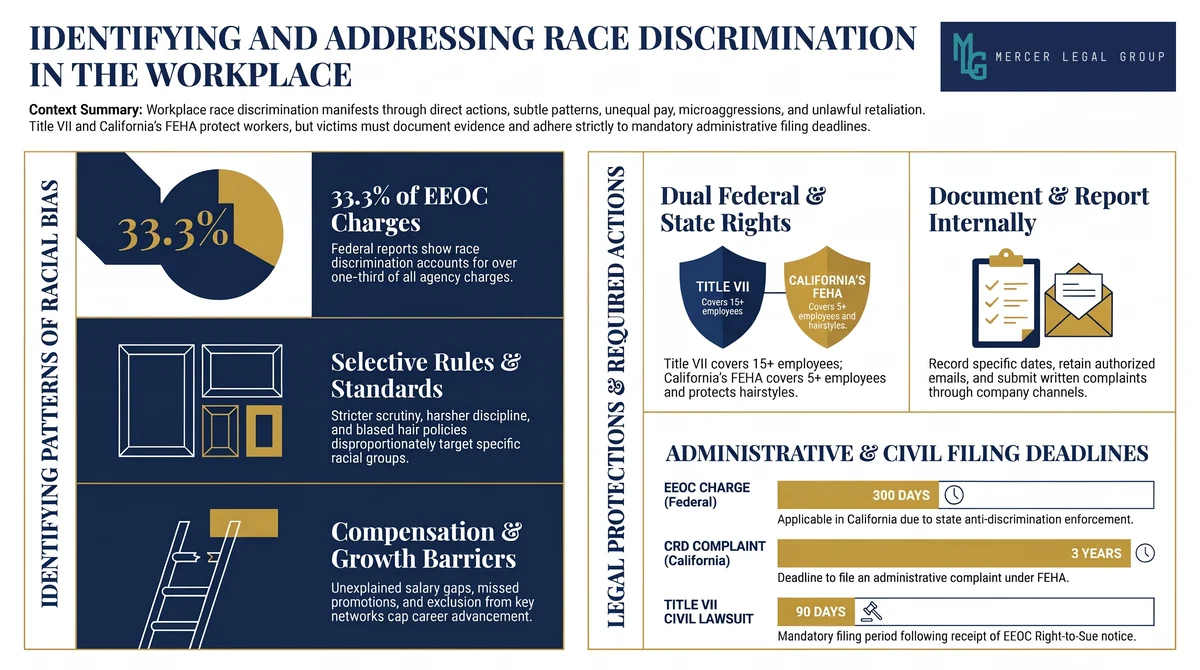
Many people face race discrimination in the workplace. In fiscal year 2025, 29,338 complaints of race discrimination were made to the EEOC. That was 33.3% of the 88,201 complaints filed, and only complaints of retaliation and disability were more common. (These numbers count complaints, not findings of unlawful discrimination.)
It may help to compare how you are being treated to others in the same role, with similar skills/capabilities. One issue may not mean much, but if people of different races are consistently treated differently, it is likely significant.
1. Different Expectations
You may be expected to perform to a higher standard than people of other races, or if you make an error you may be heavily criticized, while people of other races are not. You may be asked to prove your competence in your role more frequently. If you have received a written warning for being 5 minutes late, yet people who regularly arrive late have not received any action, this may be unfair treatment. If this is consistent, and there is no consistent justifiable reason for you to be treated differently than employees of other races, note when this occurred, what policy and treatment was applied to you, and what treatment was given to the other member of staff. Treating employees of different races differently in this manner is illegal.
2. Unfairly Seen as Less Competent
Even if you have appropriate experience and have met targets in your role, your manager may not think you are suitable for the role. This is likely due to stereotyping. Based on your accent, hair type and appearance, you may be seen as less professional or unsuitable for client facing roles. As discussed above, in California, hair type and protective styles (braids, locs & twists) are considered race.
Be aware of how people are being described. If people are acting similarly, individuals of one race may be described as confident and bold, while individuals of another race may be described as too aggressive. If stereotypes were used in recruitment, and people of different races are expected to perform to different standards in recruitment or have different progression requirements with no explanation, this is likely to be an issue.
3. Not Getting Promotions Despite Having Higher Qualifications
Even if people are not being given promotions, if consistently employees of other races with less qualifications are being given leadership roles, high profile projects, development and mentoring opportunities, while you are not, this may be an issue. If you are not being given leadership roles, high profile projects, development and mentoring consistently in comparison to others, it will limit your progression, and therefore earnings.
Check if promotion criteria is consistent. If you are performing well, however less experienced employees are being given promotions with little justification, this could be an issue. Although not getting a promotion may not indicate unlawful discrimination, if it is consistently occurring it may be a serious issue.
4. Harsh Criticism
If you have met your targets, but still received poor reviews, or are often second guessed in decision making, you may be facing race discrimination. Alternatively, if you were suspended over an issue while colleagues from other races only received verbal warnings, you may be suffering from race discrimination. This could impact your professional reputation and future progression within the company.

Compare the performance reviews, discipline and achievements you have made to what would be expected for someone in a similar role. Has there been a sudden change in expectations? Are the reasons for giving you poor performance reviews inconsistent? If you have been overly criticized since bringing up issues of racial bias/discrimination in the workplace, this may be a form of retaliation (See point 9).
5. Stereotyping, Micro-aggression and Offensive Comments
Offensive comments may be present. Individuals of different races may be subjected to racist comments, stereotyping and regular comments relating to their skin tone, culture, accent, hair type and appearance. It is common for managers to frequently make jokes relating to employees' race and assume people of a certain race are less intelligent, less trustworthy or unable to be good leaders. Coworkers may not find this an issue, however regularly making these comments may create a hostile working environment.
It is important to gather detail regarding racial harassment in order to establish if it is an issue. If racial harassment is severe or ongoing, and this is creating a hostile work environment, or causing adverse decisions in relation to your employment, then this is illegal under federal law. Make note of the comments, when they were made, who they were made to, and if they have continued after you raised concerns. This allows you to determine if it was a one-off, or if it was part of a pattern.
6. Exclusion from Informal Groups/opportunities
Sometimes, it may be difficult to identify if race discrimination is occurring. You may be excluded from team meetings, networking, mentoring, being introduced to clients or informal chats to discover new project/promotion opportunities. However, employees of a different race may be given this information, allowing them to interact with higher level management and progress in their careers.
If you are consistently being excluded from meetings compared to people in similar roles, or not regularly given high profile projects given to employees of a certain race, this may be an issue. Although exclusion from meetings may not necessarily indicate race discrimination, if you are consistently being excluded from development opportunities, decision making and progression compared to others, this may indicate racial bias.
7. Unequal Pay
Individuals in similar positions to you with similar results may be receiving higher pay. It may be obvious that people of different races are being unfairly paid. If employees of a certain race do not receive as high pay, or bonuses, extra benefits or overall better pay packages compared to other races.
There are many reasons why individuals may be receiving differing pay, including experience, seniority, skill, location and performance. Consider if there is good reasoning for the difference in pay. If people of different races are receiving different pay with no credible reasoning, this may be an issue. Note what pay you are receiving, if you received a bonus, what performance review you received and reliable information on pay for similar roles. Be careful with confidential information and legal requirements.
8. Ignoring Racial Harassment
It is very important to consider how employers handle racial harassment in the workplace. If you raise concerns regarding racial slurs/discrimination, and management do not investigate or allow this to continue, this can be a concern. Similarly, if managers do not take action to stop people showing clear racial bias in front of customers/clients this can be an issue.
Make sure you know how to raise concerns in your company. Take note of when the concerns were raised, to whom and what action was taken. If raising an official concern with HR, make sure to make copies of everything. Depending on who took the actions, what they knew and what they did, they may have legal obligations. If the company reacts poorly to this issue (or not at all) a hostile working environment may be created, indicating that they are not enforcing their anti discrimination policies effectively.
9. Retaliation
Retaliation is when an employer takes action against an employee for raising concerns regarding race discrimination or opposing discrimination. After raising concerns, you may receive negative feedback, less work may be allocated to you, you may be demoted, closely monitored or excluded from opportunities. In extreme cases, you may be dismissed. Generally actions will be taken to discourage reasonable employees from raising concerns about discrimination.
It is very important to consider the timing of any changes in treatment to see if it is an act of retaliation. If you begin to be treated differently suddenly after raising a concern, it may be retaliation. However, it may not be as the employer may have very good reasoning for making these decisions. Ensure you make copies of concerns, correspondence and previous performance reviews. Note any change in duties and treatment. Under Title VII, it is illegal for an employer to retaliate against an employee for opposing practices they reasonably and in good faith believe to be unlawful, or for participating in discrimination proceedings. Similarly, employees are protected from retaliation under FEHA. If you feel that you are facing retaliation from your manager, seek advice as soon as possible as there are time limits to claiming retaliation.
Evidence
Evidence could come in many forms such as emails and performance reviews, meeting invites, policies, evidence from witnesses, and previous complaints. These records are the core of how to prove employment discrimination in California.
In the race discrimination cases Mercer Legal Group reviews, the records that matter most are usually ordinary ones: performance reviews, disciplinary write-ups, emails and texts, and older reviews that show when the tone changed. A pattern we look for is a run of good reviews that turns negative soon after an employee raises a complaint, followed by write-ups for conduct that coworkers of other races were not disciplined for. Lined up by date, those documents often show more than any single comment. Every case depends on its own facts.
Inconsistencies – If you have been told that you were not promoted due to a lack of experience in a role, but were also told that you were not a good cultural fit in the company (despite receiving positive feedback) there is an inconsistency. If inconsistencies exist in isolation, this may not provide enough evidence to prove discrimination. But, if combined with other evidence, it can be very important. Be sure to make notes about events (and dates) however only make notes about things you are entitled to.
Just because decisions regarding employees, performance and promotions seem unfair does not necessarily mean that unlawful race discrimination has occurred. In order to be unlawful race discrimination, you must be treated unfairly based on a protected characteristic (race in this case). If there appears to be a pattern make a note of this. Then, seek legal advice from an employment lawyer.
Protection
Employees are protected from race discrimination in the workplace in California. This includes discrimination in hiring, pay, roles, disciplinary action, dismissal, and other employment decisions. Under Title VII of the Civil Rights Act of 1964, and under the Fair Employment and Housing Act (FEHA), employees are protected from race discrimination. Race (among many other characteristics) is protected under both acts meaning it is unlawful to discriminate on the grounds of race. The EEOC and the CRD can investigate complaints, aim to resolve issues and provide information about what can be done.
Title VII of the Civil Rights Act of 1964
For employers with 15 or more employees, it is unlawful to discriminate (in hiring, pay, roles, dismissal) on the grounds of race, color, national origin, sex or religion. It is also unlawful to retaliate against employees for complaining about unlawful discrimination or participating in an investigation into unlawful discrimination.
Under EEOC guidance, discrimination on the grounds of race and color is unlawful. This can occur during hiring and dismissal, pay, roles, promotion, layoffs, training, benefits and other employment conditions. It is unlawful to racially harass employees. Racial harassment can occur if it is frequent or severe, creating a hostile/deterrent working environment, or resulting in a negative outcome in employment (such as dismissal or demotion). Even if policies are fair for all employees, if it negatively affects employees of a particular race (and is not relevant to their role, nor necessary for business requirements) it is unlawful.
Fair Employment and Housing Act (FEHA) (California)
In addition to being protected from race discrimination, individuals are protected from discrimination on the grounds of color, national origin and many other protected characteristics. Under the FEHA, it is unlawful to discriminate in employment for businesses with 5 or more employees. Harassment in employment (even in businesses with 1 employee/independent contractor) is unlawful. Even if the number of employees in your workplace means that you are not protected under Title VII, you may still be protected under FEHA. As mentioned above, under FEHA race discrimination includes discrimination on the basis of hair type/protective hair styles to comply with the CROWN Act.
Complaints of employment discrimination on the grounds of race can be made to the California Civil Rights Department (CRD). Alternatively a right to sue notice can be requested and the complaint can be taken straight to Court. In both cases, a time limit must be adhered to. The time limits can be found below.
What Do the EEOC and CRD Do?
The Equal Employment Opportunity Commission (EEOC) ensures that laws against discrimination (such as Title VII) are complied with. If a complaint is made by an employee on the grounds of race discrimination, the EEOC may investigate, attempt mediation/make attempts at conciliation, or may take further action.
The California Civil Rights Department (CRD) ensures civil rights are upheld in California. This means protecting people from discrimination (such as under FEHA). Complaints of discrimination or harassment in employment can be made to them. They may investigate complaints and attempt to resolve eligible claims. Although often working in conjunction with each other, if you make a complaint to one agency, it cannot be guaranteed that the same time limits/requirements will be applied in the other agency.
Time limits can be very short. See below for more information. If time is running out, contact the correct agency or employment lawyer as soon as possible.
What to Do
If you think that you have faced race discrimination in employment, you should:

Take notes. Record the date, time, location, people involved and situation in which you felt race discrimination. Record the names of any witnesses. Record if your performance was affected. If you take notes regularly on several instances of discrimination, it may be possible to spot a pattern. Notes can be shared.
Collect evidence. Save evidence such as emails, messages, performance reviews, disciplinary action, decisions about promotions, and evidence of policies. Be sure to save this securely. Do not save confidential company information, or private information of other employees, unless permitted to.
Make an official complaint. Most companies allow complaints to be made to your supervisors, HR, or Compliance Officers. If you are facing issues with your supervisor, make a complaint to someone else in the company. Make sure to include as much information as possible including names of people involved. Request that suitable action is taken by the employer. Be sure to save a copy of your complaint, and any replies.
Note response from manager. If the manager doesn't handle the situation well (investigate appropriately, speak to witnesses, correct the problem) or if harassment continues, make a note. Follow escalation processes in your company. Even if an investigation is taking place internally, you may wish to take legal action.
Note any retaliation. If as a result of making this complaint, you have been demoted, disciplined, had reduced responsibilities, or dismissed make a note. Save evidence showing that you were treated differently. Although it is unlawful for companies to retaliate against employees for protected activity (see definitions of protected activity in Title VII and FEHA), not every poor decision counts as retaliation.
Contact EEOC/CRD or a lawyer. If making a complaint of employment discrimination, you can choose to make a complaint with the EEOC or CRD. Time limits differ depending on what body you make a complaint to and the stage in the process. Time limits can be found below. If in California, an employment discrimination lawyer can advise you on what to do next in your situation.
Time Limits
Depending on whether you make a complaint to the federal body (EEOC) or the state body (CRD), and whether you are pursuing legal action, time limits will differ. In general, 180 days is the time limit for complaints made to the EEOC. However, if the same type of discrimination is prohibited under state legislation, the time limit extends to 300 days. Therefore in most cases in California, race discrimination in employment has a 300 day time limit. If you receive a Notice of Right to Sue from the EEOC, you have 90 days to make a claim. If making a claim of employment discrimination in California to the CRD, you have 3 years to make a complaint. However, if you receive a right to sue letter from the CRD you have 1 year to make a claim. A summary of time limits can be found below.
| Filing process | General deadline | What to know |
|---|---|---|
| EEOC discrimination charge | 300 days in most California race discrimination cases | The standard federal deadline is 180 days, but it generally extends to 300 days when a state agency enforces a law prohibiting the same type of discrimination. |
| Federal employee EEO complaint | 45 days to contact an agency EEO counselor | Federal employees and applicants follow a separate complaint process with a much shorter first deadline. |
| California CRD complaint | 3 years from the alleged discriminatory act | The general deadline for filing an employment discrimination complaint under California's Fair Employment and Housing Act (FEHA). |
| Federal lawsuit under Title VII | 90 days after receiving the EEOC right-to-sue notice | This deadline generally applies when the EEOC issues a notice authorizing you to file a lawsuit. |
| California FEHA lawsuit | 1 year after the CRD right-to-sue notice | This is separate from the three-year deadline for filing an administrative complaint. |
These time limits are completely separate. Making a complaint to HR will not change these time limits. If you are facing ongoing harassment, or if you have recently experienced a decision which you feel to be discriminatory, make notes and seek legal advice as soon as possible. An employment discrimination lawyer in California can advise you on what time limits apply.
When to See a Lawyer
If you feel that decisions have been made by your employer based on your race (you have not been promoted, paid less, been harassed, unfairly disciplined, or excluded from key aspects of work) then it may be beneficial to see a lawyer. It may also be beneficial to see a lawyer if your manager hasn't handled an official complaint made by you appropriately, failed to prevent harassment, or retaliated after you raised concerns about discrimination in employment. You do not need to be dismissed from employment or in an unbearable situation to take action.

A lawyer specializing in race discrimination can help you understand what protections you have in your situation. They can look at performance reviews, emails, policies, pay, evidence from witnesses and how people of other races in similar roles have been treated in your workplace. A lawyer can advise you whether the reason given for the actions taken by your employer is accurate. A lawyer can advise you on what steps to take. These may include making an internal complaint, or making a complaint to the Equal Employment Opportunity Commission (EEOC) or the California Civil Rights Department (CRD) so that an investigation can be made. A lawyer can also negotiate a settlement or begin legal action.
Be aware of time limits. In most California race discrimination cases you have 300 days to file with the EEOC, while the federal standard elsewhere is 180 days. Please see the table above and get advice as soon as possible.
Race Discrimination Lawyers
Knowing what signs of race discrimination in the workplace to look out for can help you protect your rights. If you have been unfairly treated in terms of pay, promotion, harassed, excluded from opportunities, or faced retaliation due to race discrimination in employment, making detailed notes can create strong evidence. You are protected by law (both federal and California law), but missing a time limit or legal requirement could leave you unable to make a claim.
We see the same pattern in our own cases. In one, a long-term employee who was stopped from speaking Spanish in the office resigned, and the national origin discrimination and harassment claim resolved for $300,000. Every result depends on its own facts. Mercer Legal Group can represent employees who have faced race discrimination in employment. Contact us for a free assessment of your claim. Contact an employment discrimination lawyer to find out what steps can be taken.
Common Questions
Race discrimination in employment can occur in hiring, pay, relationships with colleagues and job security. Below are examples of race discrimination in employment, what evidence can be obtained to support these claims and where to raise concerns in California.
What Is Race Discrimination in Employment?
Race discrimination in employment can include not being given a promotion, being paid less than people in similar roles, unfairly disciplined, and being excluded from key aspects of work based on your race. Racial harassment may also occur. This could include being unfairly targeted in hair grooming policies based on natural or protective hairstyles. It may also be unlawful to retaliate against an employee for making a discrimination complaint.
Can Race Discrimination in Employment Occur Without Racial Abuse?
Yes. Race discrimination can be subtle. This could include never being given a promotion despite fitting the role, being treated unprofessionally based on stereotypes in relation to your race, or being given unequal opportunities in training or leadership roles. Even if there is no racial abuse within the workplace, anti-discrimination laws may have been breached.
How Can I Prove Race Discrimination in Employment?
Evidence can be found in emails, performance reviews, pay records, evidence from witnesses, discriminatory comments, and how people of different races in similar roles have been treated. Inconsistencies in reasoning for decisions made by employers, or differences in treatment of people may be very important. Depending on your situation and relevant laws, different evidence may be required.
Can I Be Fired for Making a Complaint About Race Discrimination?
No. It is unlawful to retaliate against employees (within the scope of the law) for making a genuine complaint, in good faith, in relation to believing that they have faced unlawful discrimination, or for participating in an investigation into discrimination. Under FEHA in California it is unlawful for employers with 5 + employees to retaliate against employees for exercising their legal rights. If you have suffered a negative outcome (being fired, demoted, being harshly disciplined or treated unfairly) as a result of making a protected complaint, make notes and seek some legal advice. This may be considered unlawful retaliation.
Where Can I Make a Complaint About Race Discrimination in California?
You can make a complaint to the federal Equal Employment Opportunity Commission (EEOC), or the California Civil Rights Department (CRD). Other employment discrimination claims can also be made to the CRD. Be aware that different time limits apply depending on which agency you make a complaint to.
Legal Statement: This content is for information purposes only. Depending on the individual circumstances, employment discrimination laws will differ. No attorney-client relationship will be created with Mercer Legal Group by reading this article. If you believe that you have faced race discrimination or retaliation in employment please contact a qualified employment lawyer to discuss your situation and options.