
Depending on the circumstances employment discrimination claims can take anywhere from several months to many years. Some claims settle after 3-12 months. If however discovery, pre-trial orders and trial are needed, these claims may take 2-4 (or longer) years. The duration of employment discrimination claims depends on how cooperative the employer is, the extent and quality of evidence, whether a settlement is reached and how quickly things are processed at court.
Mercer Legal Group offers a no-fee-unless-we-win service. Simon Moshkovich, founder of Mercer Legal Group, has trained at two very prestigious law firms, Skadden Arps Slate Meagher & Flom LLP and Latham & Watkins LLP. In 2024 Mercer secured a pre-litigation settlement of $415,000 for 4 employees experiencing a hostile work environment in Los Angeles County. It is not guaranteed that previous success can be replicated. Mercer Legal Group has only one office, located in Woodland Hills (21031 Ventura Blvd. Suite 103). We represent employees in Los Angeles County and Southern California. Our clients rate us highly in their reviews. If you are uncertain whether you can afford to pursue a claim against your employer, please take advantage of our free preliminary evaluation.
This article provides information on how long employment discrimination claims in California may take. It outlines the stages of employment discrimination claims (making claim with California Civil Rights Department, being sent a right to sue letter, discovery, mediation and trial). Reasons for delays in employment discrimination claims, when settlements may be reached, and how to avoid delays in claims to protect your rights are explained.
Length of Employment Discrimination Claims in California
Depending on a variety of factors, employment discrimination claims may take a varying amount of time. Claims may be concluded quickly if reached during mediation. However, if investigation is needed, claims may take a considerable amount of time.
In general employment discrimination claims in California are first made with either the California Civil Rights Department (CRD) or the Equal Employment Opportunity Commission (EEOC) depending on the nature of the claim. Although claims may be concluded quicker if a right to sue letter is given rather than waiting for investigation, it may take approximately:
| How the case resolves | Illustrative timeframe | What affects the timeline? |
|---|---|---|
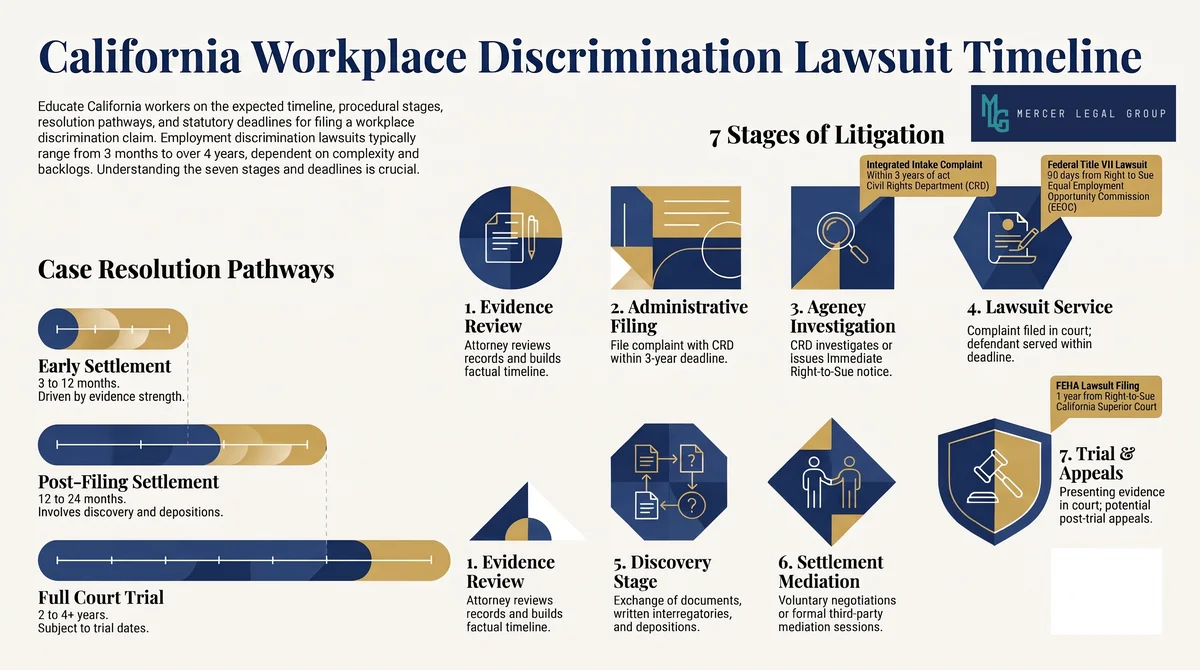
| Early settlement or mediation | Around 3 to 12 months | The strength of the evidence, willingness to negotiate, and employer cooperation |
| Settlement following the filing of a lawsuit | Around 12 to 24 months | Discovery, document exchange, depositions, and settlement negotiations |
| Lawsuit that proceeds to trial | Around 2 to 4 years or longer | Disputed evidence, pre-trial motions, expert testimony, court backlogs, and trial dates |
Within trial courts in California, 75% of unlimited claims should be concluded within 12 months of the claim being made, 85% within 18 months, and 100% within 24 months (these are targets). (Standard 2.2, California Standards of Judicial Administration). However, complex employment discrimination claims may take longer to be concluded. There is no guarantee as to how long employment discrimination claims may take to be resolved.
Reasons for Delays in Claims
Claims may be delayed due to a range of factors. These include difficulty with evidence, witness statements, lack of cooperation from the employer. Delays may also occur due to expert evidence, motions and appeals.
Having electronic evidence, paychecks, performance reviews and written complaints will help to quickly understand the claim. However, even with good evidence delays may still occur. If there is a large amount of evidence in the claim, delays may occur due to delays in court and complicated legal matters.
Stages of Employment Discrimination Claims in California
Depending on whether a complaint is made with the CRD, and whether the employer wishes to resolve the claims, employment discrimination claims in California may go through different stages. Understanding these stages may help give an idea of how long the claim may take.
1. Evidence and Claims
Evidence will be considered to be able to make a claim. Performance review, email, paycheck, HR complaints, witness statements and any other relevant evidence will be considered by your employment lawyers. Your lawyer will determine if there have been breaches of FEHA (Fair Employment and Housing Act) or Federal Laws by the employer.

By gathering evidence at an early stage, any missing evidence may be identified. A timeline should be created for the claim. This should detail the dates of the discrimination, the date the issue was raised, and how the employer has acted. Ensure any documents relating to this claim are kept safely. Do not take confidential company documents without authorization.
Ensure you know what claims can be made, and what administrative claims you need to make. This should be done quickly, as time limits may apply.
2. Making a Claim With the California Civil Rights Department
In general employment discrimination claims in California are made with the California Civil Rights Department (CRD). The CRD ensures that employees and applicants are not being discriminated or harassed in the workplace based on protected characteristics. They also ensure that employees and applicants are not being retaliated against for opposing discrimination/harassment, or making a claim.
You may wish to file a claim to be investigated, or alternatively be given a right to sue letter. If you make a claim to be investigated, evidence will be gathered. However, if a right to sue letter is given from the CRD, further investigation will not be carried out. However, legal action may be taken.
Under FEHA, claims must be made within 3 years of the last incident. In order to bring a FEHA claim to Court, you must have been given a right to sue letter. It is advised to seek advice from an employment lawyer at this stage of the claim.
3. Investigation and Right to Sue
If an investigation is requested, an investigation will be undertaken with the CRD. Documentation will be requested, witnesses will be questioned, and further information will be requested from the employer. At this point, the employer will explain what has happened and provide evidence to support their statement. Depending on the nature of the issues, strength of evidence and workload of the administrative body, the investigation may take very varying amounts of time to complete. For more information on how long investigations may take with the CRD, see below.
However, legal action may be taken at any point. If a right to sue letter is given, legal action may be taken.
Be aware of time limits. If making a FEHA claim, a claim must be made within 1 year of receiving the notice. If making a claim with the federal EEOC and receiving a Notice of Right to Sue, generally a claim must be made to Court within 90 days.
4. Making a Claim and Serving the Employer
If certain requirements have been met a legal claim may be filed in the relevant Superior Court in California. The names of the people involved, details of alleged unlawful actions and claims, and what remedy you wish to receive will be stated.
Once a claim has been made, it must be served upon the employer. Generally, employers will dispute all or part of the claims. Generally defendants have 30 days to reply to a claim once served. However, depending on certain rules and scenarios this may vary.
Time limits will be set by the Court. Evidence must be disclosed by certain dates. Case management meetings will be held so the claim progresses efficiently. This may cause delays in your claim as the courts may be very busy, and problems may have occurred with processes.
5. Discovery
Discovery is often a lengthy process. Evidence will be shared between the parties to better understand the situation. This may include documents, questionnaires and witness statements.

Your lawyer may ask for documents including performance reviews, internal communications, company policies and how similar employees were treated. Similarly, the employer may ask for documents and information relating to the claim. Both sides will consider the strengths and weaknesses of the claim.
In some cases, discovery may take many months (or more). There may be disagreements on what information should be shared in the discovery stage. This may be due to issues with recording information, internal communications, difficulty in finding witness statements or other issues. In some cases, these issues may need to be referred to a judge. However with adequate preparation, discovery may be quick. How quickly discovery occurs will depend on how complex the claim is and how cooperative the parties are.
6. Settlements
Potentially a settlement can be reached without going to trial. Negotiations may take place before legal action, during investigations with an administrative body or during discovery. To make a settlement, you may arrange for mediation. A neutral third party will be brought in to help reach an agreement.

A settlement may mean compensation, or changes to processes in the business. A settlement can be cost effective and eliminate uncertainty, giving more control over the outcome. However, it is completely optional to reach a settlement and may not be successful in all cases.
If mediation is done by the EEOC, settlements are usually quick. On average disputes may be resolved within less than 3 months. If an investigation takes place, however, disputes may be resolved within 10 months (or longer depending on a wide variety of factors). These times apply to federal administrative claims.
Before agreeing to a settlement, ensure you discuss all aspects of the settlement with your lawyer. This should include compensation, legal costs, releasing claims, confidentiality and any other requirements. You should consider how this compares to what risks and costs you may face if you continue with your claim.
7. Trials and Appeals
If a settlement cannot be reached, the claim may go to Trial. Witnesses may be prepared and physical evidence may be collected. Motions may be made to the judge to decide on legal issues and issues with evidence. As a result, decisions can be made as to what claims and evidence should be taken to the Jury. Motions may cause delays.
Both parties present their case. This may include presenting witness statements, evidence and expert evidence. The judge or jury will decide on what level of liability each party has, and what remedy should be provided.
Post trial, or if applicable, appeals may be made by either party. Depending on the issues within the claim, and how quickly things are moving in the Court reviewing the claim, this may cause major delays. Many complex employment claims can take much longer than the 24 month target set by the Judicial Council.
What Factors Can Make a Discrimination Lawsuit Take Longer?
Depending on the circumstances, employment discrimination claims in California may be quick to resolve, or may be significantly delayed. Knowing possible reasons for delays may allow you to have realistic expectations.
The complexity of the claim, cooperation from the employer, quality of evidence, and how quickly decisions are made by the court may all affect how quickly a claim is resolved. With appropriate preparation, and cooperation from the employer, avoidable delays can be avoided. Delays caused by court processes and limited trial dates cannot be avoided.
Common causes for delays in employment discrimination claims:
Complex Claims
If a claim involves multiple claims, multiple employees or decision makers, investigations may take longer. If multiple claims have been made (discrimination, harassment, retaliation and pay inequality), specific evidence needs to be found for each claim. Due to conflicting facts and expert opinions, more preparation may be required.
Conflicting or Limited Evidence
If there is limited evidence, or conflicting evidence in emails, paychecks, performance reviews, complaints to HR or witness statements, delays may occur. If key documents are missing, the employer disputes your claim, or it is difficult to obtain witness evidence, delays may occur. Although detailed documentation in claims makes them easier to understand for people, it does not necessarily mean they will be quick to resolve.
Lack of Cooperation from Employer
If the employer is cooperative with providing evidence, and negotiating in good faith, the claim may move quickly. However, if there are disputes in discovery and motions to dismiss claims, and a negative attitude by the employer, delays may occur.
Delays in Court
Even if both parties are ready to move forward with a claim, delays may occur due to delays in the court process. If there are not enough judges available, very full court calendars, or requests for continuances, trials may be significantly delayed. This can be very frustrating as neither you nor your lawyer have control over delays in the court.
Settlement Negotiations
Settlements can be made without going to trial, and may allow claims to be resolved quickly and cheaply. If there are disputes over compensation, liability and settlements, settlement negotiations may be delayed. Settlement negotiations often occur heavily during discovery and shortly before trial. It is hard to estimate how long settlement negotiations may take.
Multiple Claims and Motions
Multiple employment claims may mean more evidence, analysis and witness statements are required. If pre-trial motions are made, delays may occur. If there is a dispute as to whether certain claims should be pursued, or certain evidence should be allowed in to the case, it may take months to resolve. As a result delays may occur.
Which Delays Can You Control?
Although not all delays in employment discrimination claims can be avoided, some delays may be minimized.
Avoidable Delays:
- Evidence (emails, paychecks, performance reviews, HR complaints) should be gathered as early as possible.
- Create a timeline detailing key facts, decisions and witnesses.
- Reply fully and quickly to requests from lawyers.
- Consider what you would like in a settlement, as early as possible.
Partly Within Your Control:
- Lack of cooperation from employer, or disputes over evidence (early, complete records make these easier to resolve).
- Difficulty in obtaining witness or third party information (a list of witnesses and contact details helps).
Unavoidable Delays:
- Delays in court, and limited trial and hearing dates.
- Decisions on motions, post-trial motions and appeals.
Even if employment discrimination claims take a long time to be resolved, it does not necessarily mean that they are a weak claim. Claims may be delayed due to conflicting evidence, or complex legal issues. However, claims may be delayed for completely unrelated reasons. Your lawyer should be able to advise as to why delays may have occurred.
Can You Settle a California Discrimination Lawsuit Before Trial?
Yes, you can resolve a workplace discrimination case before filing a lawsuit, during when an agency is investigating, or after litigation has started. Settling avoids the time, uncertainty, and expense of a trial, but it only works if both sides are willing to negotiate. You don't have to wait till your trial date before you start talking; you can begin right away.
The U.S. Equal Employment Opportunity Commission (EEOC) provides free mediation for people whose cases of discrimination are eligible. According to the EEOC's Fiscal Year report for 2024, Annual Performance Report, the agency successfully resolved 8,543 out of the 11,998 mediations conducted in that year which translates to a success rate of 71.2%. That figure covers EEOC mediations, not all California discrimination lawsuits, but it shows how often disputes end without a trial. As the EEOC figures above show, mediation generally moves quickly.
When Can a Settlement Happen?
Settlement can happen at different times. You and your attorney can negotiate with your employer before filing a lawsuit, or the California Civil Rights Department (CRD) or EEOC can help the parties talk while it reviews your complaint. Once litigation starts, settlement often becomes more likely after both sides exchange documents, depose witnesses, and see the evidence.
Negotiations can go on throughout the stage of preparing for the trial; they can occur even after a date has been set by the court. CRD also offers mediation services for legitimate complaints. Parties work together towards an agreement facilitated by a neutral third party. A successful mediation ends the investigation or litigation quickly.
What Can a Discrimination Settlement Include?
A settlement doesn't have to be all money. Depending on the facts of the case, you could get compensation for wages that you lost, benefits you lost, for distress that has happened emotionally, or other things that can be recovered as well. An agreement can also include reinstatement, a promotion, changes to workplace policies, supervisor training, or terms covering employment references and records.
Availability depends on laws that apply, details specific to your case and what both sides agree to. The CRD's employment page lists back pay, front pay, hiring or reinstatement, promotion, out-of-pocket expenses, policy changes, training, reasonable accommodations, emotional distress damages, punitive damages, and attorney's fees and costs among the remedies for employment discrimination.
What Should You Consider Before Accepting a Settlement?
Before you sign a settlement agreement, make sure to go over the terms carefully with your employment lawyer. Take note of the amount in dollars involved. So do the likely value of your claims, the strength of your evidence, the risks of trial, and the time and cost of keeping the case going. Weigh the offer against all of it.
Find out how much money from your paycheck will be used for things like legal fees and litigation. Also double check for any charges that will come out of your recovery and that any outstanding debts have been settled. Read the release of claims closely, because signing it usually means giving up the right to bring the released claims against your employer later.
Take a look at any confidentiality clauses and other limitations before you agree to them and find out what discussions you will still be allowed to have and whether there are any legal exceptions that apply. Taxes deserve attention too. IRS Publication 4345 explains that the part of an employment discrimination settlement paid for lost wages, such as back pay or front pay, is taxable as wages, and emotional distress damages not tied to a physical injury are generally taxable as well. A tax professional can tell you if a proposal for payment fits your particular case.
How Long Does the California Civil Rights Department Take to Investigate Discrimination?
The California Civil Rights Department (CRD) handles complaints about discrimination, harassment and retaliation at work that follow the laws called California's Fair Employment and Housing Act (FEHA). When you file an employment discrimination complaint, the agency reviews your allegations, requests documents from your employer, interviews witnesses, and decides whether the evidence supports further action.
Generally, the CRD agency has up to one year from when a complaint is filed to complete its investigation. The actual timeline varies depending on how complicated the issue is, how strong the evidence is and how busy the agency is as well. Some investigations wrap up sooner while others need the full year.
An administrative investigation is not the same thing as filing a lawsuit. The CRD process involves investigating your complaint and deciding what steps the agency should take next. A civil lawsuit means court filings, evidence exchange, depositions, settlement talks, and possibly a trial. If you request a right-to-sue notice, you can go to court without waiting for the CRD to finish, but the CRD will not investigate a complaint once that notice issues.
How Long Do You Have to File a Discrimination Claim in California?
If you've experienced workplace discrimination in California, know the filing deadlines before you decide what to do. Under California's Fair Employment and Housing Act (FEHA), you generally have three years from the date of the alleged discriminatory act to file an employment discrimination complaint with the California Civil Rights Department (CRD).
Different federal claims have different procedures. The EEOC's page on filing time limits sets a general 180-day deadline that extends to 300 days where a state or local agency enforces a law prohibiting the same type of discrimination. Because the CRD enforces FEHA, most Title VII and ADA charges in California fall under the 300-day limit, though the rules for age discrimination charges differ slightly. Federal employees and job applicants follow a different process and generally must contact an agency EEO counselor within 45 days.
After filing with the CRD, you can request a right-to-sue notice if you'd rather pursue a FEHA lawsuit than wait for the agency's investigation. Once CRD issues their notice you generally have one year to file your lawsuit. Federal claims run on a shorter clock: under Title VII and several other federal discrimination laws, the EEOC's guidance on filing a lawsuit gives you 90 days after you receive a Notice of Right to Sue.
Don't assume reporting discrimination to HR or waiting for an agency to do something will automatically extend those deadlines. Different rules apply depending on the type of case and claim involved; therefore, contact a labor lawyer promptly to learn about applicable deadlines.
How Can You Avoid Unnecessary Delays in Your Discrimination Case?
You can't control every detail of a lawsuit for discrimination in California, but you can avoid unnecessary delays. Keeping on top of evidence, answering promptly to requests, and communicating regularly with your employment lawyer keeps things moving forward during the course of the legal proceedings.
| What you should do | How it helps prevent delays |
|---|---|
| Organize relevant documents by gathering emails, performance reviews, HR complaints, disciplinary notices, pay records, and witness information. | Lets your attorney assess the allegations, identify supporting evidence, and prepare your employment claims. |
| Respond promptly to requests. Send requested information to your lawyer or the agency as soon as you reasonably can. | Reduces delays caused by missing information, incomplete submissions, or unanswered questions. |
| Maintain a factual timeline of discriminatory incidents, employment decisions, complaints, and changes in your employer's behavior. | Establishes the sequence of events and shows gaps that need more investigation. |
| Preserve evidence lawfully. Keep authorized copies of relevant communications, do not delete records, and do not access restricted systems or take confidential information without permission. | Protects the evidence while reducing the risk of confidentiality breaches or disputes over how records were obtained. |
| Discuss settlement goals early. Tell your attorney which outcomes are most important to you, whether related to compensation, reinstatement, or another remedy. | Lets your attorney judge settlement proposals and negotiate with your priorities in mind. |
| Keep communication consistent. Tell your attorney right away about new developments, employer responses, or potential witnesses. | Gives your legal team time to address new issues before they become complications. |
Evidence-Readiness Checklist for Your First Attorney Consultation
Before seeing an employment lawyer, go through this checklist to sort out what you have. You don't need every item to have everything ready before you seek legal advice and you should not wait until you have collected all things before talking to someone about it.
- A timeline of the incidents and relevant employment decisions
- Copies of relevant emails, messages, and written communications
- Past and recent performance reviews or disciplinary notices
- Copies of complaints submitted to HR and any responses
- Pay records, promotion decisions, or job assignment information
- Names of potential witnesses and what they saw or heard
- Copies of any CRD or EEOC filings and right-to-sue notices
- Upcoming deadlines, hearings, or employer response dates
Being prepared lets your lawyer know the facts, recognize legal claims, and figure out what to do next. Some delays will happen anyway, especially discovery disputes, an uncooperative employer, or a crowded court calendar.
Need To Speak With a California Employment Discrimination Lawyer?
A California employment discrimination case can take months or years to resolve, depending on the evidence, the complexity of your claims, settlement talks, and whether the case goes to trial. Knowing your rights and getting your evidence ready early puts you in a better position at every step. Filing deadlines are strict, though, and waiting for your employer or an agency to fix the problem can cost you legal options.
Mercer Legal Group represents workers from California on behalf of clients who have filed claims alleging discrimination at work along with claims for retaliation and wrongful termination. Our lawyers look into your specific situation, explain what legal protections apply to you, and guide you through your options of seeking compensation or other means of remedy.
Contact Mercer Legal Group today for a free consultation. Tell us what happened, get answers to your questions, and decide on your next step.
Frequently Asked Questions
If you are considering filing a discrimination claim you probably have some have questions about how long the legal process takes and what to expect step by step. The responses below touch on typical time frames, settlement options, and what an employment lawyer can do for you.
Can a California Discrimination Lawsuit Be Resolved in Six Months?
If both sides resolve things quickly either by settling directly or by having good mediation work fast, then discrimination cases in California can be settled within six months. A lawsuit that is contested lawsuit with heavy discovery along with disputed over evidence or trial preparation takes a very long time.
Does Every Workplace Discrimination Case Go to Trial?
No. Many disputes about discrimination at work settle through settlement negotiations or mediation before they ever go to trial. If they cannot reach an agreement then the matter will move forward through trial based on the claims and procedural matters at hand.
Can I File a Discrimination Lawsuit While the CRD Is Investigating My Complaint?
You can usually bring a California Fair Employment and Housing Act lawsuit before the California Civil Rights Department (CRD) finishes its investigation by requesting a right-to-sue notice. After doing this, CRD will stop looking into that complaint. The specific procedures depend on what claims you have; before you file anything be sure to consult an employment lawyer to confirm the proper procedure.
Does Hiring an Employment Lawyer Make a Discrimination Case Faster?
An employment lawyer gathers evidence, keeps track of deadlines for submitting paperwork, fulfills procedural requirements and looks for ways to resolve issues. Hiring one doesn't ensure a faster resolution, though, because discovery disputes, employer cooperation, and court scheduling still affect the timeline.
What Happens if My Employer Appeals a Discrimination Verdict?
When an employer appeals a verdict of discrimination, the higher court looks into the legal points that were brought up and decides whether the judgment stands or if more proceedings are necessary. An appeal extends the dispute beyond the trial, and how long it takes depends on the issues and the court's schedule.
Legal Disclaimer : This article is informational only and should not be considered legal advice. Employment discrimination laws, filing deadlines, and legal procedures vary depending on the circumstances, and reading this article does not create an attorney-client relationship with Mercer Legal Group. Speak with a qualified employment lawyer in California regarding your specific case.