
If you think that you have an issue in your workplace, we recommend you contact us for a free case review. Signs that you may be facing workplace discrimination include:
If you are facing any of these issues within your workplace, it is worth considering whether you are facing workplace discrimination, and what protections you may have in place within the US (or state of California). If you have faced one instance of unfair treatment in the workplace, this does not necessarily mean that you have faced discrimination. If however, you have continuously faced discrimination (based on protected characteristics) and have been able to gather evidence, you may be facing workplace discrimination. Please note that there is a time limit for these claims.
Signs of Workplace Discrimination
Have you faced workplace discrimination?
If you are not being promoted in your workplace, or receiving negative feedback, or being paid less as a result of being in a protected group (Race, Nationality, Religion, Gender, Disability, Age) you may be facing discrimination. Alternatively, if you are receiving extreme unfair treatment as part of a protected group you may be facing workplace discrimination. Many people in the US face workplace discrimination. People may be facing subtle discrimination (not being invited to important projects) or clear discrimination (making employee feel uncomfortable with inappropriate comments).
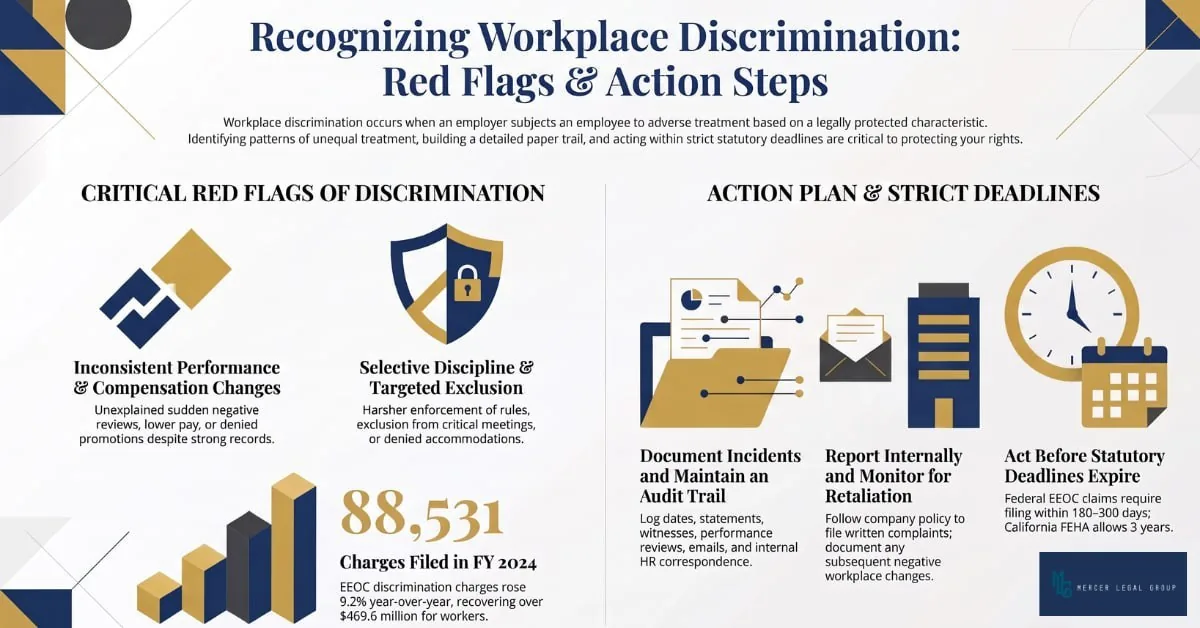
If you are facing unfair treatment as part of a protected group, and facing a pattern of unfair treatment in the workplace, you may be facing workplace discrimination. 88,531 new discrimination cases were reported to the EEOC in 2024. This is an increase of 9.2% compared to last year. In the private and state/local sectors, over $469.6 million was paid to employees in 2024 via mediation, conciliation or agreement. Despite it appearing that many employees in Federal or State employment have faced workplace discrimination in 2024, it may not be illegal discrimination.
Lack of Promotion
If you are facing discrimination regarding promotions it may be because:
- You are not being promoted despite performing well in the role;
- Or employees in a similar role, with similar qualifications to you, are being promoted and you are not;
- Or people with specific protected characteristics (Race, Gender, Nationality, Age or Disability) are not being promoted.
What to do
Consider what criteria was required for promotion. Have you met these criteria? (performing well in role / completing certain projects / positive feedback from manager). Writing down notes may be beneficial. Try to find out what criteria was required to gain promotion in a similar role to yours, and whether those people met these criteria. While it may not always be possible to get this information, writing down any knowledge you have may be useful.
Write down all promotions you have applied for. What criteria did you meet? Were you successful? Why/why not. This information may help Employment Lawyers understand your situation. A table may be a useful way of presenting this information. Ask your manager for clarification as to why you were not given a promotion.
Negative Performance Reviews
If you are receiving negative performance reviews, this may be an issue. If you were previously receiving positive performance reviews, but following a dispute, discrimination claim or change in expectations, you are receiving negative performance reviews, you may be facing unfair treatment. If you are unfairly being held responsible for errors made by other people, or receiving poor performance reviews for missing deadlines / poor or inaccurate work, you may be facing unfair treatment.
However, this may not amount to discrimination. If people in a similar position to you are receiving the same standard, and you appear to be receiving unfair treatment based on protected characteristics (rather than poor quality of work), you may be facing workplace discrimination. Note down your past performance reviews, recent feedback, targets and formal warnings. When have requirements changed? Why? If you received feedback as a result of making a discrimination claim, when was this?
Unfair Pay
Unfair pay can occur if you are paid less than people in similar roles, or if you are receiving less of a bonus for similar performance to people in similar roles, or if you are not receiving the same benefits as people in similar roles. Depending on what legislation applies to you, unfair pay may amount to discrimination. Under federal legislation, men and women should receive equal pay for substantially similar work.
Under California law, (Labor Code 1197.5) generally employees should receive equal pay for substantially similar work as someone of a different sex, race or ethnicity. (Equal skill, effort and responsibility, in similar working conditions). What pay (bonus) are you receiving? What position are you in? What level of experience, performance and responsibility do you have in that role? What is known about pay levels for people in this position? Even if you do not know all of this information, writing down notes may be helpful.
It is unlawful to face workplace discrimination based on race, nationality, religion, disability and age. If you think you are being unfairly treated in the workplace based on your gender (or other protected characteristic) and there is no justifiable reason for the difference in pay (for example in terms of experience or merit), it may be worth contacting an employment lawyer. For example, if you are being paid less than colleagues in similar positions without a justifiable reason, you may be able to make a claim.
Inappropriate Comments in Relation to Protected Characteristics
If inappropriate comments or assumptions have been made regarding your protected characteristics (Race, Gender, Religion) by management, you may be facing discrimination. The number of inappropriate comments/assumptions made by management will be an important factor in determining whether this amounts to unlawful discrimination. In California, single incidents of unlawful discrimination are weighted heavier than under federal legislation. If there has only been one inappropriate comment/assumption (unless it was extremely inappropriate) you may not be able to make a claim.
However, if there have been multiple inappropriate comments/assumptions, you may be able to make a stronger claim. If you have been demoted, received negative performance reviews or dismissed due to multiple inappropriate comments/assumptions, this would strongly suggest that discrimination has occurred. Write down what inappropriate comment/assumption was made, when, who was present, and what the response from management was. Where possible, save any relevant emails or correspondence. If colleagues in the workplace can support your claim, this may be useful. Even if you may not be able to make a full claim, it is still worth contacting an attorney for further advice.
Missed Opportunities
If you are regularly missing out on opportunities compared to people in similar positions within your workplace, you may be facing workplace discrimination. This could be missing out on meetings, projects or mentorship/training. For example, if you are responsible for a key client in the company, but are not being invited to meetings regarding this client, or if key projects are regularly given to less experienced employees. Consider if you are missing out on opportunities compared to people in similar positions.
Are you being given less interesting or less important tasks? Are there patterns to you missing out on certain meetings? Are you not being given mentorship/training, that you regularly see given to other employees? Consider if a reason was given for you missing out on these opportunities, and whether it is likely to be a result of discrimination. If you have only missed out on one opportunity in your work, it may be coincidence.
However, if you regularly miss out on opportunities in work which would be beneficial to your career progression, and this relates to you being in a protected group, this may be a problem.

Treated Severely
If you feel that you have been treated unfairly compared to other employees in the workplace, consider if this is the case. Have you been reprimanded formally for arriving late to work multiple times, while other employees with similar attendance records have not? Have you been heavily criticized for taking a break, changing your working pattern, or making small mistakes, while other employees who have done the same have not?
Have policies been applied differently to you compared to other employees? If possible, try to find out if other employees in similar situations to you (and receiving similar disciplinary action) have been treated differently. Comparing the situations may be useful. (Policy, Situation, Action taken by employer, Action taken to other employees). Even though being treated unfairly compared to other employees does not necessarily mean that you have faced discrimination, it helps to note down any unfair treatment. If there is a pattern, this can show if you were treated fairly by your employer.
Reasonable Accommodations Not Made
If you believe that you have faced discrimination, or reasonable accommodations have not been made to support you in accordance with the PWFA, ADA, Title VII or California FEHA (due to disability/ pregnancy/ religion) we recommend you contact an attorney who handles disability and accommodation discrimination cases. Reasonable accommodations may include flexible working hours, changes in the way people work, or allowing employees to carry out key parts of their role.
Generally, under the Americans with Disabilities Act, employers must make reasonable accommodations to allow qualified disabled people to carry out their role, unless this would cause undue hardship. (EEOC Disability Discrimination Fact Sheet). Employees with genuine religious beliefs are protected under Title VII of the Civil Rights Act of 1964. Employers must make reasonable accommodations to support employees with these beliefs to complete their roles, unless this causes significant difficulty.

Under the Pregnant Workers Fairness Act, from June 27, 2023, employers must make reasonable accommodations (unless it would cause undue hardship) to allow employees with known limitations for pregnancy, childbirth or related medical conditions, to effectively complete their role. (EEOC Guidance on PWFA). Under FEHA, in California, employees cannot be discriminated against due to their sex (pregnancy, childbirth, breastfeeding/nursing and related medical conditions). Therefore, employers in California must make reasonable accommodations to support employees with known disabilities.
Under Pregnancy Disability Leave Laws in California, companies with 5 or more employees must allow employees with medical difficulties due to pregnancy, childbirth or related medical conditions to take up to 4 months leave. (Civil Rights Department). You can read more about pregnancy discrimination in California. Note down what reasonable accommodation(s) you requested, why, and what your supervisor/HR said. Note how your employer responded.
If reasonable accommodation(s) were not granted, ask your employer to put this in writing. If you were pressured into withdrawing your request, punished for requesting reasonable accommodations, or reasonable accommodation(s) were not granted without explanation, you may be able to make a claim. In some situations, your employer may be unable to make reasonable accommodations for you. This may be because they are able to prove that it would cause undue hardship in the business (ADA/PWFA) or significant difficulty (religion, Title VII).
Harassment
If you are being subjected to unwelcomed treatment at work based on a protected characteristic (racism, religious insult, sexual harassment, disability insult, or intimidating comments based on nationality), you may be facing a hostile work environment. However, this may not always amount to unlawful harassment. If the treatment has caused you to be unable to perform within the role, or is severe, recurring, or would cause a reasonable person to be in a hostile, uncomfortable or abusive situation, it may amount to unlawful harassment.
(EEOC guidance). In California, it may be easier to make a claim. If you have experienced one instance of harassment in the workplace which has caused unreasonable impacts on performance, or made you feel in a hostile, uncomfortable or offensive situation, it may mean that you are in a hostile work environment. (Added to Government Code 12923 via SB 1300 2018). (California law is generally more favorable to employees in harassment claims than federal law).
If you are in a hostile working environment at work, it is recommended to document in detail what has happened, who has been involved, and save any correspondence. What response did your manager give to this issue? There should be clear procedures in place to deal with harassment in the workplace. If this issue persists, or is being ignored by management, it may be useful to consult with an employment lawyer who handles hostile work environment cases to establish if you have a possible claim for harassment / discrimination based upon the facts.
Reprisal
You may be facing reprisal at work. This may have occurred as a result of bringing a concern of discrimination to HR, being involved in an investigation, or supporting a colleague in making a claim. As a result of this you may be receiving increased scrutiny from your manager, be losing key aspects of your role, given unexpected warnings or be recommended for dismissal. Generally, it is illegal to be given reprisal by an employer for taking legal action.
If you have made a discrimination claim, or been involved in investigations, you are protected from reprisal. (EEOC guidance). However, reprisal may be a claim in itself. Even if you were unsuccessful in your original discrimination claim, you may have a claim for reprisal. Although you may not necessarily be facing reprisal, it may be useful to create a chronology of when the issues occurred, who knew, and what has happened since.
It may also be useful to note any complaint made, responses from HR, performance reviews, disciplinary letters, or relevant correspondence. If you wish to make a strong claim, comparing any new criticism to previous performance is useful. You can read more about retaliation claims in California.
Multiple Reasons
If you have been given multiple reasons for decisions made regarding you (not being promoted – due to lack of experience or poor performance) or disciplinary action/termination, and these reasons do not match up with previous written feedback, or feedback from HR, you may have concerns. Although it may be very legitimate for employers to give multiple reasons for decisions, if further information is discovered during investigations, it may indicate that decisions in your favor were not made due to a protected characteristic.
Note any multiple reasons given for decisions made by your employer. Consider if these reasons seem appropriate for the situation, in line with company policy and requirements of the role.
Evidence
To highlight patterns of treatment, it may be useful to produce a list. If you think you may be facing discrimination, creating a list of unfair treatment you have received and comparing it to how people in similar roles have been treated may be useful. Note when you received unfair treatment and who may have witnessed this. Even if you are unsure if you are facing discrimination, it may be useful to make notes of any concerning situations in order to allow your employment lawyer to easily identify if discrimination may have occurred.
| Notes to Make | Reason: | |
|---|---|---|
| List of events | Who was involved? What was said? Who witnessed? | To highlight patterns of discrimination. |
| Performance reviews | Past and recent feedback. What targets were met and improvements. | To highlight unexpected poor performance and unfair standards. |
| Emails / Correspondence | Any correspondence regarding promotion, disciplinary action, work in role, or discriminatory comments. | To highlight what the employer knew, and reasons for decisions made. |
| Complaint with HR | A copy of the complaint, confirmation that a complaint was made, details of what investigations were made and responses. Evidence of discrimination. | To highlight changes in treatment. |
| Pay / Benefits | Details of pay, bonuses, benefits. What pay you should be legally entitled to. | To highlight discrimination with pay. |
| Application for Promotion / Task | Criteria, suitability, tasks and reasons for promotion. | To highlight unfair opportunities for promotion. |
| Hours of Work / Annual Leave | Information on hours of work / annual leave, timesheets and any relevant disciplinary action. | To highlight unfair treatment with company policy and harsher disciplinary action. |
| Request for Reasonable Accommodations | Evidence of request for reasonable accommodations to work to account for a disability/pregnancy/religion and the response from your employer. Evidence of alternative solutions. | To highlight if the employer may have appropriately considered their responsibilities. |
| Witnesses | Names of people who may have witnessed relevant situations. | Useful to support your case if the employer disputes that events occurred. |
| Policies | Company policies in place. | May give insight into discrimination, harassment, reasonable accommodations and disciplinary action. Compare to treatment. |
Considerations
Even if you are unsure if discrimination has occurred, it may be useful to raise concerns with an employment lawyer.
Note discrimination. When did it occur? Where? Who was involved? Who witnessed? What was said? By whom? Save any relevant documentation regarding your work (performance reviews, emails, written reports). Note any patterns. Try to find evidence of people in similar roles being treated more favorably. For example, if people in a similar position to you have been promoted, given a pay rise or had no written warnings in comparison to you not having these, it is significant.
Be aware of any anti-discrimination policies in place in the company. Check your employee handbook / HR to ensure you know what to do and who to speak to if you have faced discrimination in the workplace. Know that there is a process in place if discrimination is investigated. If you want to raise concerns regarding discrimination at work, it is important that you follow the correct process.
You may be encouraged to raise concerns with your line manager. However, they may encourage you to raise concerns with HR or another manager. If you have faced discrimination by your line manager, it may be useful to raise concerns with a manager in a different department.
Raising Concerns
It may be useful to raise concerns with your employer. However, it is important that you follow the correct procedure. Clearly set out your concerns. Include as much detail as possible. What happened? When? By whom? Why do you think this discrimination occurred? Be careful not to make assumptions. Include evidence if possible. If raising concerns verbally, it may be useful to follow it up with an email. Note what concerns you raised and the responses from HR.
If you make a grievance, this does not affect any time limits for making claims elsewhere. You do not need to wait for a response to any grievances in order to make legal claims or seek legal advice.
Generally, negative consequences should not be suffered by employees for raising awareness of unlawful discrimination or involvement in investigations in discrimination / other protected matters. These negative consequences may include changed working conditions, disciplinary action, poor performance in reviews, removal of responsibilities and threatening comments. However, even if negative consequences have occurred as a result of raising concerns, this may not constitute a retaliatory action. Be aware of any changes to working conditions in the workplace as a result of making a discrimination concern.
If you believe that negative decisions have been made as a result of raising a concern, it is very important to be aware of the circumstances. It may be that your employer is unlawfully treating you. Seek legal advice.
If you are continually facing discrimination in the workplace, or if you believe that your concern was not taken seriously, or if you feel that you may be facing a retaliatory action (such as dismissal or demotion) as a result of raising a discrimination concern, it may be useful to consult an employment lawyer. They can advise you on what Federal and State discrimination laws may apply to your situation, and whether your employer may be acting unlawfully by discriminating against you.
They can advise on what evidence may be useful to prove discrimination in your situation and may be able to advise solutions to your problem. This may include raising concerns with the employer, raising a concern with an administrative body or making a legal claim.
Time Limits
We recommend raising concerns with your manager as soon as possible. Generally claims of discrimination in employment must be raised with the Equal Employment Opportunity Commission (EEOC) within 180 calendar days of the discrimination. However, if there is an equivalent body in your State / Local area enforcing laws to prevent this same form of discrimination, claims must be made within 300 calendar days. However, as there is an equivalent body in California (Civil Rights Department (CRD)), generally claims in California must be made within 300 calendar days.
Different time limits may apply to discrimination based on age and discrimination in Federal employers. However in California, additional considerations apply. If making a claim of discrimination / harassment in employment, claims must be made to the CRD within 3 years of the last act of harassment / discrimination. This time period increased from 1 year to 3 years from January 1, 2020 as a result of Assembly Bill 9.
According to the CRD website, employment-related complaints must be made within 3 years from the last time you were adversely affected. However exceptions may apply. Different time periods may apply. For safety, it is best to contact the relevant body or employment lawyer as soon as possible. Raising a concern with HR may not increase the time limit for making claims externally. Getting legal advice as soon as possible can mean that you are aware of what time limit applies to your case, can preserve evidence and find solutions.
Advice from Employment Discrimination Lawyers
If you have been demoted / dismissed / disciplined for raising concerns regarding discrimination or supporting discrimination concerns made by colleagues, have not been promoted / paid the same as people in similar positions, reasonable accommodations have not been made to support you in disability / pregnancy / religion with no genuine reasons given by your employer, or regularly face increasing levels of harassment in the workplace, or are unsure whether you are running out of time to make a claim, an employment discrimination lawyer can consider evidence from emails, performance reviews, complaints with HR and statements from witnesses and differing treatment to establish whether Federal (Title VII of the Civil Rights Act 1964 and Americans with Disabilities Act) or State discrimination laws (FEHA in California) may apply in your situation.
Depending on the facts of your situation, solutions to your situation may include internal resolution, making a complaint with an administrative body, negotiating a solution or making a legal claim. Not all unfair treatment in employment constitutes unlawful discrimination. Depending on the circumstances of your situation, relevant legislation and evidence, the strength of a claim may differ. An employment lawyer can consider all of this to decide what action to take.
If you believe that you have faced employment discrimination, we can be very helpful. Please do not delay in seeking legal assistance as there may be time limits.

Employment Discrimination
Have you faced discrimination in employment? Have you not been promoted? Have you been given unfair performance reviews, pay and disciplinary action compared to others? Consider if this is as a result of a protected characteristic. If so, note this may be evidence of discrimination. If you have faced employment discrimination in California, we may be able to help. Please contact us to see what options you may have regarding employment law.
While not all unfair treatment in employment constitutes unlawful discrimination, it may be beneficial to be aware of whether discrimination is occurring in the workplace. If you make notes of this, it may help you understand better what is happening in the workplace and what you may be able to do. If you are unsure what options you may have in law, or are concerned that you may be running out of time to make a claim, it is best to seek legal advice as soon as possible.
Common Questions
What is common in employment discrimination?
Unfair treatment regarding pay rises and promotions, different performance reviews / disciplinary action, no reasonable accommodations, discriminatory comments / behavior, regularly being excluded from activities due to a protected characteristic.
Can I be facing discrimination without knowing?
Sometimes discrimination can be subtle. Depending on the situation, and the evidence, it may be useful to consider whether you may be facing discrimination based on a protected characteristic. If you are being excluded from meetings, not being given development / training opportunities or are being held to different standards, you may be facing employment discrimination.
Is all unfair treatment employment discrimination?
Not always. Employees may be unfairly treated regarding performance, hours of work and promotion for legitimate reasons. However, if employees are being unfairly treated due to a protected characteristic, or for any other reason relating to illegal practice, federal / California laws may have been broken.
What should I do if I feel my manager is discriminating against me?
If you feel that you are facing employment discrimination, make notes of any potentially discriminatory situations (what happened, when, what was said, who was involved). Raise your concerns following the correct process. If you are unsure of what to do or your legal rights, we recommend you seek legal advice as soon as possible. Particularly if discrimination is ongoing or if you may be running out of time.
Can I be fired for raising concerns of discrimination?
Under both federal and California law it is unlawful to retaliate against an employee for making discrimination claims or taking part in discrimination investigations. Whether or not being fired for making a discrimination claim constitutes unlawful retaliation depends on many factors. This includes specific circumstances, the reason for taking the protected action (making discrimination claims) and what laws may be relevant to your situation.
How long do I have to make a discrimination claim in employment?
Generally employment discrimination claims must be made to the EEOC within 180 calendar days of discrimination. If there is an equivalent body in your state / locality enforcing laws to prevent this same type of discrimination, 300 calendar days may apply. Likewise, as there is an equivalent body in California (Civil Rights Department (CRD)), generally employment discrimination claims in California must be made within 300 calendar days. Generally, harassment / discrimination claims in employment must be made to the CRD within 3 years of the last act of alleged discrimination / harassment under FEHA.
However this period increased from 1 year to 3 years from January 1, 2020 due to Assembly Bill 9. Different periods may apply depending on the type of claim and how it is made. It is extremely important to know what time limit applies to you as soon as possible. Do not wait for an internal investigation.
This information is general information only. It does not constitute legal advice. No relationship will be formed with Mercer Legal Group as a result of you reading this information or contacting Mercer Legal Group.