
TL;DR: California employers who miss fixed payday or final-pay deadlines can owe $100 for an initial violation, $200 plus 25% of unlawfully withheld wages for later ones, and up to 30 days of an employee’s daily wage rate when final pay is late. Waiting time penalties, wage-statement fines, and retaliation exposure can stack on top of the unpaid wages themselves.
California law requires employers to pay wages on fixed paydays, and an employer who misses those deadlines can owe $100 for an initial violation, $200 plus 25% of the amount unlawfully withheld for later ones, and up to 30 days of the employee’s daily wage rate when final pay is late. California wage laws are among the strictest in the country, and these labor laws set exact paydays, exact final paycheck deadlines, and real statutory penalties rather than vague obligations.
Why a Late Paycheck Hurts More Than the Missing Dollars
Getting paid on time is not a courtesy, and a paycheck that lands a week late can cascade into a missed rent payment, an overdraft, and a late fee that no penalty fully repairs.
How Mercer Legal Group Helps California Workers
Mercer Legal Group represents California employees in wage and hour and overtime disputes, and does not represent employers. Simon Moshkovich, admitted to the California Bar in December 2018 after practicing at Skadden Arps and Latham & Watkins, has been involved in matters resulting in recoveries totaling over $8 million. The firm handles cases on contingency, so there are no upfront fees and no fee unless there is a recovery. If your employer keeps paying you late or still owes you a final paycheck, contact us for a free case evaluation.
This article covers the payday rules, how waiting time penalties are calculated, what employers risk, how to file a wage claim, and when to bring in a lawyer.

Overview of Late Payment of Wages in California
California wage payment laws set the schedule, and it is more specific than most people realize. Under Labor Code section 204, work performed between the 1st and the 15th must be paid between the 16th and the 26th of that same month, and work performed between the 16th and month’s end must be paid between the 1st and the 10th of the following month. The Division of Labor Standards Enforcement summarizes these DIR payday and pay-period rules in plain language for workers and employers.
An employer that runs weekly, biweekly, or semimonthly payroll can use that schedule instead, provided wages are paid within seven calendar days of the close of the payroll period. Exempt executive, administrative, and professional staff may be paid monthly, on or before the 26th. Collective bargaining agreements can set different schedules for covered workers.
Final Paycheck Deadlines After Discharge or Quit
Final paycheck deadlines are tighter still. If an employer fires you, Labor Code section 201 makes the wages earned and unpaid at discharge due immediately. If an employee quits without notice, section 202 gives the employer 72 hours, and giving 72 hours of notice entitles you to final pay on your last day.
Final wages cover everything earned: your hourly pay or salary, overtime wages, commissions, and accrued vacation, since unused vacation time counts as earned wages in California. Direct deposit does not change any of these deadlines. Workers chasing unpaid wages and commissions often discover the final-pay clock started the day they left.
What Are the Waiting Time Penalties in California?
Waiting time penalties are the teeth behind the final pay rules. Under Labor Code section 203, when an employer willfully fails to pay a worker his or her wages on time at separation, those wages continue as a penalty at the same rate until paid, up to 30 days.
The word “willfully” matters. A willful failure means the employer intentionally did not pay wages that were due, and a genuine good faith dispute about whether the money is owed defeats the penalty even if the employer later loses that argument. A dispute invented after the fact does not count.
How Waiting Time Penalties Are Calculated
The calculation is simpler than people expect, and it is where most explanations go wrong. Take the employee’s daily wage rate and multiply it by the number of days the employee’s wages remain unpaid, capped at 30. Those are calendar days, not business days, which the Court of Appeal confirmed in Mamika v. Barca (1998) 68 Cal.App.4th 487, so weekends and holidays count.
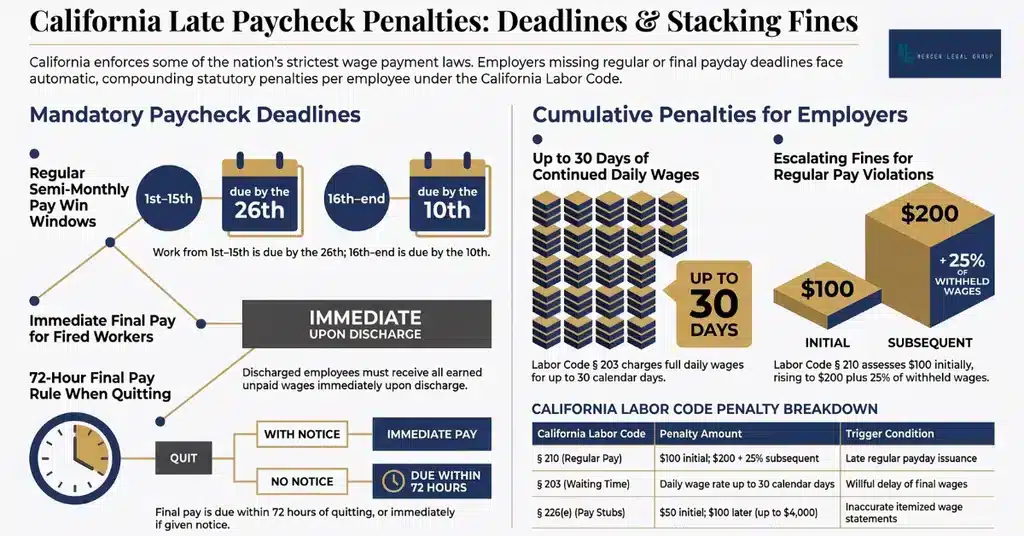
Someone whose hourly wage works out to $200 a day and who waits the full 30 days is owed $6,000 in waiting time penalties, separate from the wages owed. Waiting time penalties apply whether the employee quits or is fired. They belong to the worker rather than the state, and they keep running until the employer pays.
What Are the Legal Implications of Delayed Payments for Employers?
An employer that misses payday faces stacked exposure rather than one tidy fine. Section 210 penalties apply to late wage payments under the regular payday rules, and waiting time penalties apply on top when final pay is late.
If the pay stub is also wrong, Labor Code section 226 adds penalties for a knowing and intentional failure to provide accurate itemized wage statements. It starts at $50 for the initial violation and $100 per employee for each subsequent pay period, capped at $4,000, plus actual damages, costs, and attorney’s fees.
Workforce Exposure, Retaliation, and Enforcement
The exposure multiplies across a workforce. These penalties employers face are assessed per employee and, for wage statements, per payroll period, so a systemic error affecting fifty workers over six months is not one violation but hundreds. Interest, back pay, and the employee’s attorney’s fees ride along with many claims.
An employer who retaliates against whoever complained faces a separate problem under Labor Code section 98.6, which presumes retaliation for adverse action within 90 days of protected activity and allows up to $10,000 per employee per violation, payable to the worker. That exposure often overlaps with retaliation claims and whistleblower protection theories when the complaint concerned wages.
Enforcement is not hypothetical. California’s Bureau of Field Enforcement issued nearly 2,100 citations between January 2022 and August 2025, recovering over $43.7 million in stolen wages, penalties, and interest for workers. Federally, the U.S. Department of Labor’s Wage and Hour Division recovered more than $259 million in back pay for 176,957 employees in fiscal year 2025.
What Is the Impact of Late Payments on Employees?
The financial damage from a late paycheck rarely matches its size. Rent does not move because payroll slipped, so a delayed deposit becomes an overdraft fee, a late fee, and sometimes a credit hit that outlasts the missing money by years.
For anyone without savings, one late paycheck can force a choice between groceries and a utility bill. The personal side is just as real: repeated payroll errors keep people in low-grade financial anxiety, and workers who cannot rely on their income often stay in jobs they would otherwise leave.
A few steps limit the damage. Ask payroll in writing for a specific date, since a written request creates a record and usually works faster than a hallway conversation. Keep every pay stub, time record, and message about the delay, because a wage dispute turns on documentation.
Contact creditors early, as many waive a fee for a documented payroll issue. If lateness becomes a pattern, start a claim rather than waiting it out. Pattern delays also surface in broader employment law reviews when workers later face discipline or a rushed exit.
How to File a Claim for Late Paycheck in California
Most workers qualify. You can file a wage claim if you were paid late, not paid at all, or are still owed final pay, and that covers hourly and salaried employees regardless of immigration status. True independent contractors cannot use this process, though workers are frequently misclassified, so being labeled a contractor does not settle the question—see independent contractor misclassification and employee misclassification when the label looks wrong. There is no filing fee, and you can recover unpaid wages and penalties through the same claim.
Bring documentation. Pay stubs, time records, bank statements showing when deposits actually landed, your offer letter, and any texts or emails about the missing money all help. If you no longer work there, note the exact date you quit or were fired and whether you gave notice, since that single fact determines which deadline applied to your former employer. The state’s DLSE wage claim filing guide walks through the Initial Report or Claim (DLSE Form 1).
Step-by-Step Claim Process
Filing with the Labor Commissioner’s office, part of the Division of Labor Standards Enforcement (DLSE), follows a set path. Here is what happens and roughly when.
The Five Stages of a DLSE Wage Claim
- File the Claim Form — Submit the Initial Report or Claim, known as DLSE Form 1, online, by mail, by email, or in person at a local office. Filing costs nothing, and you do not need a lawyer to do it.
- Wait for the Deputy’s Assessment — Within 30 days of filing, a deputy labor commissioner notifies both sides whether the claim is heading to a settlement conference, to a hearing, or to dismissal. This is the point where incomplete documentation causes problems, so respond quickly to any request.
- Attend the Settlement Conference — A deputy meets informally with both sides to discuss the claim and explore resolution. Many wage disputes end here, and anything agreed becomes binding.
- Go to the Hearing if It Does Not Settle — A hearing under Labor Code section 98(a) is scheduled within 90 days of the decision to hold one, and both sides testify under oath. It is less formal than court but is a real hearing with a record.
- Receive the Decision — The hearing officer issues an Order, Decision or Award within 15 days after the hearing closes. Either side can appeal it to the superior court, where the case is heard afresh.
Legal Support and Resources
You do not have to manage this alone. The Labor Commissioner’s office publishes plain-language guides on California employment law and takes claims directly, and its district offices answer questions about the process. Legal aid organizations and worker centers help with wage claims statewide, often at no charge, and small claims court is an option for smaller amounts if you would rather skip the administrative route.
Legal guidance matters most once a claim grows past a single missed paycheck. An attorney can spot claims a worker would miss, such as wage statement violations, meal and rest break violations, or misclassification hiding underneath a late payment problem, and can judge whether the Labor Commissioner or a civil lawsuit fits better. Most plaintiff-side firms, including our law firm, review these cases at no cost and work on contingency.
What Are the Potential Penalties for Late Paycheck Issuance?
The penalties come from different sections of the California Labor Code, and they stack rather than replace each other. The table below breaks down what each one covers.
Penalty Amounts by Labor Code Section
| Penalty | Amount | When it applies |
|---|---|---|
| Labor Code § 210, initial violation | $100 per employee | Failure to pay wages on the regular payday |
| Labor Code § 210, subsequent or willful | $200 per employee plus 25% of wages unlawfully withheld | Repeat or intentional late payment |
| Labor Code § 203 waiting time penalty | Daily wage rate, up to 30 calendar days | Willful failure to pay final wages on time |
| Labor Code § 226(e) wage statement | $50 initial, $100 per later pay period, $4,000 cap | Knowing and intentional inaccurate pay stubs |
| Labor Code § 98.6 retaliation | Up to $10,000 per employee per violation | Adverse action for complaining about wages |
Repeat offenders carry the highest long-term cost, because this structure punishes patterns rather than accidents. A single missed deadline draws the $100 initial violation. Repeating it moves an employer that fails to pay employees on time into the $200 plus 25% tier, and because the penalty attaches per employee per pay period, a practice left uncorrected for a year produces liability that dwarfs the underlying wages. Since January 1, 2020, employees have recovered the section 210 penalty directly rather than waiting for the Labor Commissioner.
Why Patterns Cost More Than One Missed Payday
The damage is not only financial. A public citation, an adverse order, decision, or award, or a civil lawsuit becomes part of an employer’s record, and where clients and job applicants check, that follows the business. Employers who face enforcement usually rebuild their payroll practices anyway, adding compliance systems they could have adopted earlier for a fraction of the cost.
How Can an Employment Attorney Help?
An attorney’s first contribution is diagnostic. Workers arrive focused on one late check, and a lawyer reviewing pay stubs and time records often finds several claims running in parallel: unpaid overtime pay buried in miscalculated rates, missing meal or rest premiums, inaccurate wage statements, or vacation time never paid out. Each carries its own statutory penalty and its own legal deadline, so a case’s value often turns on what gets identified early.
The second is strategic. A lawyer can weigh filing with the Labor Commissioner against a civil lawsuit, a real trade-off involving speed, discovery, and recovering court costs and attorney’s fees. Counsel also answers the employer’s defenses, including the good faith dispute argument that defeats waiting time penalties, and preserves a retaliation claim if the employer reacts badly. When separation paperwork appears, a severance agreement review and any employment contract disputes should be checked before rights are waived.
How Stacked Wage Claims Look in Practice
Consider how these elements fit together. Picture a Los Angeles warehouse worker whose paychecks run days late for months, who is then fired and waits three weeks for final pay. Reviewing her records, an attorney identifies section 210 penalties for the repeated late payments, waiting time penalties at her daily rate for each calendar day the final pay was withheld, unpaid overtime from a miscalculated regular rate, and accrued vacation that was never paid out.
Counsel gathers the records, files on her behalf, and handles the settlement conference. This case illustrates how these claims stack rather than describing a particular client, and every case turns on its own facts. Pattern delays that end in a firing also raise possible wrongful termination issues when the timing tracks a wage complaint.

Need Help Recovering Lost Wages in California?
Timely pay is a legal obligation under California labor laws, not goodwill, and the Labor Code backs it with specific deadlines and real money. Knowing the payday rules, final paycheck deadlines, and the up-to-three-year window for most wage claims lets you act while the evidence is fresh and the deadline is open.
If your employer fails to pay you on time, start documenting today and get advice from an employment attorney before the deadline passes. Compliance protects employers too, since fixing payroll always costs less than defending it.
Still waiting on a paycheck your California employer should have already paid? Mercer Legal Group represents California employees in wage and hour and overtime disputes. Led by Simon Moshkovich, who was admitted to the California Bar in December 2018 after practicing at Skadden Arps and Latham & Watkins, the firm has handled matters resulting in more than $8 million in recoveries. We work on contingency, so there are no upfront fees and no fee unless there is a recovery. If your employer is paying you late or has not given you your final paycheck, contact us for a free case evaluation.
Frequently Asked Questions
A late paycheck isn’t just annoying. California actually attaches real dollar penalties to it, and those penalties stack fast. Here are the questions we hear most from workers dealing with this issue.
What Are the Penalties for Late Paychecks in California?
A late regular payday costs $100 per employee for a first violation, rising to $200 plus 25% of the withheld wages for repeat or willful violations under Labor Code section 210. Late final wages add your daily wage rate for up to 30 calendar days under section 203, and inaccurate pay stubs bring their own penalties under section 226. These amounts stack rather than replace each other, so one payroll failure can trigger more than one statute at once. Employees can recover the section 210 penalty themselves through the Labor Commissioner since January 1, 2020. Interest, costs, and attorney’s fees often ride along with the underlying unpaid wages. The practical result is that a single missed deadline is rarely the whole bill once waiting time and wage-statement claims are counted.
How Much Are the Daily Penalties for Late Paychecks in California?
The waiting time penalty equals one day’s wages at your regular rate for each day your final pay is late, up to 30 calendar days. Someone earning $160 a day who never gets paid over that full period is owed an extra $4,800, and weekends and holidays count toward the total under Mamika v. Barca. The clock generally starts when final wages were due under Labor Code sections 201 or 202 and stops when the employer pays or a court action begins. Filing a DLSE wage claim alone does not stop the penalty from accruing. Overtime is counted in the daily rate only when it is regularly scheduled. The penalty belongs to the worker, not the state, and it runs whether the employee quit or was fired.
What additional penalties apply to late paychecks in California?
Wage statement violations under Labor Code section 226 carry $50 for a first offense and $100 per pay period after that, capped at $4,000, when the failure is knowing and intentional. Interest on unpaid wages, court costs, and attorney’s fees are often recoverable too. Retaliation against an employee who complains about wages can cost up to $10,000 per violation under section 98.6, payable to the worker. Section 210 penalties for late regular paydays stack with waiting time penalties when final pay is also late. Across a workforce, these amounts attach per employee and, for wage statements, per payroll period, so a systemic error quickly multiplies. Public citations and adverse awards also become part of an employer’s compliance record.
What Should an Employee Do if They Have Not Received Their Paycheck on Time in California?
Ask payroll in writing for a specific payment date and keep that response, then hold onto your pay stubs, time records, and bank statements showing when deposits actually landed. A written request creates a record and usually moves faster than a hallway conversation. If the money is not resolved quickly, file a free wage claim with the Labor Commissioner; you do not need a lawyer to start that process. Talk to an employment attorney if the pattern repeats, if you were let go without final pay, or if you suspect unpaid overtime or meal and rest premiums underneath the delay. Contact creditors early when a late deposit risks fees. Do not sign a severance agreement that waives wage claims before someone reviews it.
What legal action can an employer face for consistently issuing late paychecks?
A pattern of late pay exposes an employer to escalating section 210 penalties, waiting time penalties on any late final pay, and a lawsuit or Labor Commissioner claim for the wages owed plus interest and fees. These penalties apply per employee and per pay period, so a practice affecting many workers can lead to significant liability. Employees generally have three years to bring most wage claims. Retaliation after a complaint adds separate exposure under Labor Code section 98.6. Enforcement is active: California’s Bureau of Field Enforcement has issued thousands of citations and recovered tens of millions in stolen wages and penalties in recent years. Fixing payroll early almost always costs less than defending a stacked claim later.
What is a waiting time penalty under California Labor Code section 203?
A waiting time penalty is the statutory consequence when an employer willfully fails to pay final wages on time after a discharge or quit. Under Labor Code section 203, wages continue as a penalty at the employee’s daily rate until paid, capped at 30 calendar days. Willful means the employer intentionally failed to pay wages that were due; a genuine good faith dispute about whether money is owed can defeat the penalty even if the employer later loses that argument. A dispute invented after the fact does not count. The penalty is separate from the underlying wages and belongs to the worker. Weekends and holidays count. Payment of the wages or filing a court action stops the clock; a DLSE filing alone does not.
How long does an employer have to issue a final paycheck in California?
If an employer fires you, Labor Code section 201 makes wages earned and unpaid at discharge due immediately. If you quit without notice, section 202 gives the employer 72 hours. Giving at least 72 hours of notice entitles you to final pay on your last day. Final wages cover hourly pay or salary, overtime, commissions, and accrued vacation, because unused vacation counts as earned wages in California. Direct deposit does not extend these deadlines. Missing them can trigger waiting time penalties under section 203 at your daily rate for each calendar day of delay, up to 30 days. Keep the exact separation date and whether you gave notice, because that single fact sets which deadline applied.
What happens when an employee does not submit a timecard before payday?
California’s Labor Commissioner explains that an employer still must pay wages on the established payday even if a timecard was not submitted. There is no exception that lets the employer wait until the next payday or until the card is turned in. The employer can comply by paying all wages it reasonably knows are due for the regularly scheduled work period, then true up later if needed. Holding an entire paycheck for paperwork is itself a late-payment problem under the payday rules. Workers should still turn in accurate time records and keep copies, because documentation matters if a shortfall appears. Written follow-up asking for a specific pay date strengthens any later wage claim.
How long do employees have to file a wage claim for late pay in California?
Most California wage claims, including unpaid wages tied to late paychecks, generally run on a three-year limitations period, though some penalty theories are shorter. Labor Code section 210 penalty claims often carry a one-year window, so waiting can forfeit part of the recovery even when the wages themselves remain timely. Waiting time penalties under section 203 follow their own timing rules tied to the final-pay violation. Filing with the Labor Commissioner preserves the administrative path; a civil lawsuit is a separate choice with different discovery and fee features. Because stacked claims can sit on different clocks, early advice protects value. Start gathering stubs, bank records, and separation dates while the evidence is fresh.
What counts as a good faith dispute that can defeat waiting time penalties?
A good faith dispute exists when the employer presents a defense based in law or fact that, if successful, would preclude recovery of the wages claimed. Under the Labor Commissioner’s regulations, an ultimately unsuccessful defense can still show good faith if it was reasonable and supported by evidence. A defense that is unsupported, unreasonable, or presented in bad faith will not defeat waiting time penalties. Disputes invented after separation, or shifting stories that ignore clear time records, usually fail this test. The dispute must concern whether wages are due, not merely inconvenience or cash-flow timing. Workers strengthen their position by preserving offer letters, commission plans, and messages that show the amounts were never genuinely contested.
How do California payday rules work under Labor Code section 204?
Labor Code section 204 sets the regular payday schedule most private employers must follow. Work performed between the 1st and the 15th must be paid between the 16th and the 26th of that same month, and work from the 16th through month’s end must be paid between the 1st and the 10th of the following month. Employers that run weekly, biweekly, or semimonthly payroll may use that schedule instead if wages are paid within seven calendar days after the period closes. Exempt executive, administrative, and professional employees may be paid monthly on or before the 26th. Collective bargaining agreements can set different schedules for covered workers. Missing these windows exposes the employer to section 210 penalties per employee.
What documents help prove a late paycheck claim in California?
Pay stubs, time records, and bank statements showing when deposits actually landed are the core proof in a late-paycheck case. Keep your offer letter, commission plan, and any texts or emails about the missing money. If you no longer work there, write down the exact date you quit or were fired and whether you gave notice, because that fact controls the final-pay deadline under sections 201 and 202. Screenshots of the payroll portal and calendared payday schedules help show what was promised versus what arrived. Organize records in date order before you file with the Labor Commissioner or speak with counsel. Strong documentation also supports related claims such as wage-statement errors, unpaid overtime, or misclassification hiding under the delay.
Legal Disclaimer
Disclaimer: This article is for informational purposes only and does not constitute legal advice. Reading it or contacting Mercer Legal Group does not create an attorney-client relationship. Wage claims depend on the specific facts of each case, and no particular outcome is implied. If you need advice about your situation, consult a licensed California attorney.