


At Mercer Legal Group, our wrongful termination attorneys represent employees in Woodland Hills and Los Angeles County. We handle discrimination, retaliation, and whistleblower cases. If you believe you have been wrongfully terminated, contact our experienced wrongful termination lawyers in Los Angeles today for a free consultation.
In Los Angeles, wrongful termination refers to when an employee is fired in violation of California law, including protections against discrimination, retaliation, or termination that breaches public policy or an employment contract. While Los Angeles follows California’s statewide employment laws, local ordinances, like the Los Angeles Fair Chance Initiative for Hiring or city-specific anti-discrimination rules, can provide additional protections for workers.
Employees facing termination in Los Angeles have the right to challenge illegal firings and may be entitled to remedies such as lost wages or reinstatement. Common wrongful termination scenarios include being fired for reporting harassment, whistleblowing, taking legally protected leave, or refusing to engage in illegal activities.
Both state and federal laws protect employees from unlawful terminations. State laws include the California Labor Code and Fair Employment & Housing Act (FEHA). Federal laws include Title VII and the Americans with Disabilities Act (ADA). These employee termination laws ensure employees have multiple avenues to seek remedies after employment disputes, including reinstatement, back pay, and damages for emotional distress or punitive claims.
A wrongful termination lawyer in Los Angeles is essential for protecting your rights and increasing your chances of recovering damages. The local expertise of an experienced employment attorney ensures familiarity with both California employment laws and Los Angeles-specific legal nuances, giving you an advantage in navigating negotiation, mediation, or litigation processes. Key ways a lawyer can assist include:
Investigating claims and gathering evidence: Collect emails, employment contracts, performance reviews, witness statements, and other documentation to support retaliation claims, constructive discharge allegations, or other wrongful termination scenarios.
Legal assessment and strategy: Evaluate whether your case qualifies under California law, including FEHA, Labor Code violations, or federal protections like Title VII or the ADA, and develop a tailored plan for damages recovery.
Negotiation and mediation support: Represent you in settlement discussions or alternative dispute resolution, advocating for lost wages, benefits, emotional distress damages, or other compensatory remedies.
Litigation and court representation: Handle filings, motions, and hearings in Los Angeles courts, ensuring compliance with procedural requirements and the six-month statute of limitations for filing a complaint with the DFEH.
Settlement talks and trial preparation: Advise on the strengths and weaknesses of your case, negotiate favorable settlements, and prepare for trial if mediation fails.
Specialized knowledge: Offer advice on wrongful termination cases in specific industries like tech, entertainment, healthcare, or hospitality, where unique situations may lead to claims of constructive discharge or retaliation.
Comprehensive damages recovery: Pursue economic damages (lost past and future wages and benefits), non-economic damages (emotional distress), and, where applicable, punitive damages against egregious employer conduct.
Hiring a wrongful termination lawyer in Los Angeles, California provides several benefits. You gain local legal insight and strategic guidance during negotiation, mediation, and litigation phases. Additionally, you receive strong advocacy for achieving fair compensation and protecting your professional reputation.
Learn how our Los Angeles wrongful termination lawyers can fight for your rights.
Wrongful termination can take many forms under California law, affecting employees across all industries. Understanding the specific types of claims can help workers identify if their firing was illegal and seek appropriate legal recourse. Below are some of the most common categories of wrongful termination cases.
California laws protect employees over the age of 40 from being fired, demoted, or denied opportunities based on age under both state law and the Age Discrimination in Employment Act (ADEA). Employers cannot make employment decisions solely on an employee’s age, as this violates California age discrimination laws. These violations may include subtle bias, coercive retirement practices, or denial of promotions.
Statistics indicate that age discrimination claims represent a significant portion of wrongful termination lawsuits, with thousands of cases filed annually in California. Employees who suspect age-based termination should document performance reviews, emails, or statements suggesting bias.
Under the Family and Medical Leave Act (FMLA), eligible employees in California are entitled to take unpaid, job-protected leave for medical reasons or to care for family members. Wrongful termination during FMLA leave occurs when an employer fires, disciplines, or retaliates against an employee for taking or requesting leave.
FMLA attorneys in California typically gather documentation of leave requests, medical certifications, and employer communications to prove retaliation or interference. They also assist in negotiating reinstatement, settlement agreements, lost wages, or other damages, guaranteeing the full protection of the employee’s rights under both federal and California family leave laws.
Wrongful termination can also occur when an employer violates a written or implied employment contract. Even for an “at-will” employee, contracts, whether explicit or implied through company policies, offer letters, or consistent practices, can create enforceable obligations that protect employees from arbitrary firing.
A termination counts as a breach of contract when an employer fails to follow agreed-upon procedures, lays off an employee without cause when the contract requires it, or violates promised terms like severance or notice periods. Employees facing such situations should document agreements and communications, as these records are key to pursuing damages or enforcing their contractual rights in California.
Remote employees in California enjoy the same legal protections against wrongful termination as on-site workers under California remote employee laws, including safeguards against discrimination, retaliation, and violations of employment contracts or public policy. These laws apply regardless of where the work is performed, meaning remote employees can pursue claims for retaliation, constructive discharge, or other unlawful firing practices just like their in-office counterparts.
However, remote workers face unique challenges, such as proving termination motives without in-person witnesses or office documentation and navigating communications that occur primarily online. Local wrongful termination lawyers in California help remote employees by gathering digital evidence, reviewing employment agreements, and guiding clients through negotiation, mediation, or litigation to secure damages and protect their rights.
Recognizing the various types of wrongful termination claims in California enables employees to identify potential violations of their rights. The table below provides a quick comparison of common termination scenarios, the legal protections that apply, and the remedies available under California law.
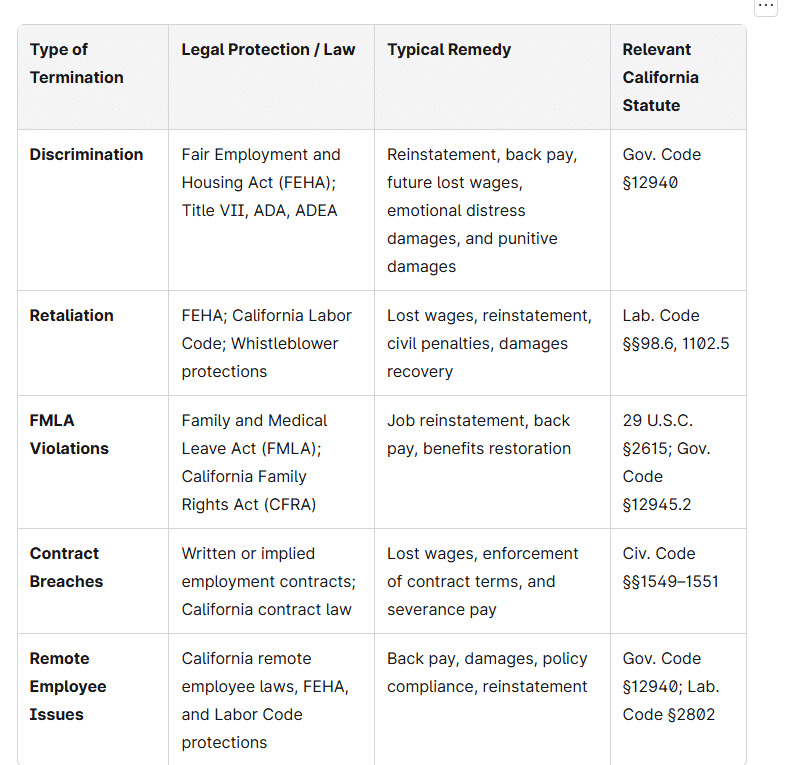
Employers sometimes take actions that may seem routine but can actually constitute wrongful termination under state or federal law. Understanding these unlawful practices can help employees recognize when their rights have been violated and take appropriate action.
Employers cannot terminate your employment because of your race, age, gender, sexual orientation, or other protected status. Sudden poor reviews after years of outstanding performance, replacement by someone outside your protected class, or discriminatory comments before termination are all signs of illegal discrimination.
This is the most common wrongful termination claim, often referred to as retaliatory termination. Your employer cannot fire you for reporting sexual harassment, filing a wage complaint, making a workers’ compensation claim, or refusing to break the law.
California protects employees who report illegal activity, fraud, or safety violations. This applies whether you reported to management or to a government agency.
If you have an employment contract limiting termination, firing you outside those terms is wrongful discharge. An implied contract can exist through employee handbooks or verbal promises from management.
Constructive termination may occur when employers make conditions so bad that you feel you must quit. If your employer deliberately created unbearable working conditions to force you out, you may have legal claims similar to those for being fired, as this is considered wrongful termination.
California has strong employee protections. Several state and federal laws apply:
FEHA: Protects employees from discrimination and harassment based on race, age, gender, disability, religion, and other protected characteristics under California law. It also prohibits retaliation against workers who assert their rights or participate in investigations.
Title VII: A federal law that bans workplace discrimination based on race, religion, sex, and national origin. Title VII of the Civil Rights Act applies to covered employers nationwide and provides remedies such as back pay and injunctive relief.
Labor Code: Safeguards employees who report workplace violations, engage in protected activities, or file workers’ compensation claims. These provisions also prohibit employer retaliation and allow terminated employees to seek civil penalties and damages.
FMLA/CFRA: Protects your job and benefits when you take qualifying medical or family leave for serious health conditions or caregiving needs. Employers may not terminate or retaliate against employees for requesting or using protected leave.
Whistleblower Laws: Shields employees who report illegal conduct, fraud, or safety violations to supervisors or government agencies. These laws provide strong protections against retaliation and support claims for reinstatement and damages recovery.
Wrongful termination cases are legally complex, and California employers almost always deny wrongdoing by offering alternative explanations for termination. An experienced wrongful termination attorney understands these defense strategies and knows how to challenge them effectively. Legal representation guarantees that your claim receives serious consideration from the outset.
Employers rarely admit to illegal motives and often rely on pretexts such as alleged performance issues or company restructuring. A skilled employment attorney works to uncover the real reason for the termination by gathering critical evidence, including emails, performance reviews, witness statements, and a detailed timeline of events.
Wrongful termination claims are subject to strict filing requirements and statutes of limitations, with some claims requiring administrative filings with agencies like the EEOC before a lawsuit can proceed. An attorney ensures all deadlines are met, your claim follows the correct legal process, and court procedures are properly navigated if the case goes to trial.
Potential remedies can include unpaid wages, future earnings, lost benefits, emotional distress damages, and, in some cases, punitive damages. A Los Angeles wrongful termination lawyer can assess the value of your claim and help you pursue full financial compensation based on the facts of your case and the applicable laws.
Our Woodland Hills wrongful termination attorneys evaluate your case, identify legal violations, and determine the strongest claims available. We gather employment records, communications, and witness statements to establish what happened. If your employer violated California labor laws, we pursue compensation through negotiation or litigation. You stay informed at every stage while we handle the legal process.
employment
Personal Injury
Simon Moshkovich founded Mercer Legal Group to represent employees. His training at NYU School of Law and experience at top firms gives clients an advantage.
We represent employees, not employers. We know the tactics companies use and how to counter them.
You pay no attorney fees unless we recover compensation. No upfront costs.
Gather your termination letter, performance reviews, emails, and employee handbook.
Save texts and voicemails. Write down what happened while it’s fresh.
California law gives you this right. Get copies of all documents about your employment.
Your employer may offer severance in exchange for a release. Have an attorney review it first.
You may be giving up valuable claims.
Wrongful termination claims have deadlines. Some are as short as one year.
Get your case evaluated. Early action preserves evidence and protects your rights.
If you believe your termination may have been illegal, taking the right steps early can protect your rights under California employment law and strengthen your potential claim. Acting promptly and strategically is especially important under California’s strict employment law deadlines.
Document your termination and related communications
Save termination letters, emails, text messages, performance reviews, and any written explanations given by your employer to help establish the employer’s stated reason for firing you.
Gather witness statements or evidence: Identify coworkers, supervisors, or HR personnel who may have witnessed discriminatory conduct, retaliation, or sudden changes in treatment, and preserve any relevant documents or timelines.
Contact a wrongful termination lawyer promptly: An experienced Los Angeles employment lawyer can assess your claim, explain your legal options, and ensure you do not miss critical filing deadlines.
File complaints with relevant agencies if needed: Certain claims require filing with agencies such as the EEOC or California Civil Rights Department before a lawsuit can proceed, and a lawyer can guide you through this process properly.
Get legal advice tailored to your situation from an expert wrongful termination lawyer in Los Angeles.
Simon Moshkovich founded Mercer Legal Group with a mission to fiercely advocate for employees’ rights. His training at NYU School of Law and experience at leading law firms provide clients with a strategic advantage in complex employment matters. With a focus on personalized guidance and proven results, Mercer Legal Group is committed to helping employees navigate wrongful termination and other workplace disputes with confidence.
If you’ve been fired and believe it may have been illegal, you likely have many questions about your rights and options. This FAQ section answers common concerns about wrongful termination in Los Angeles, helping you understand the legal protections available and steps you can take.
In Los Angeles, wrongful termination occurs when an employee is fired in violation of federal, state, or local laws, such as discrimination, retaliation for reporting illegal activity, or exercising protected rights. It can also include firing that breaches an employment contract or violates public policy, like terminating someone for refusing to break the law.
In California, you generally have six months from the date of your termination to file a complaint with the California Department of Fair Employment and Housing (DFEH) for claims like discrimination or retaliation. If your claim involves a breach of contract or other civil action, the statute of limitations may vary, typically two to three years depending on the claim type.
Yes, you can sue for wrongful termination as a remote employee, as employment laws generally protect workers regardless of location. Your case will usually follow the laws of the state or country where you perform your work or where your employment contract is governed.
In a wrongful termination lawsuit, you can recover economic damages such as lost wages, benefits, and potential future earnings. You may also be entitled to non-economic damages like emotional distress, and in some cases, punitive damages if the employer’s conduct was especially malicious or egregious.
To prove wrongful termination in court, you must show that your firing violated employment laws, such as discrimination, retaliation, or breach of contract, often using evidence like emails, witness statements, or company policies. You also need to demonstrate a direct link between your protected activity or status and the termination decision.
Disclaimer: This blog post is for informational purposes only and does not constitute legal advice. Please consult a qualified wrongful termination lawyer in Los Angeles, California, for advice specific to your situation.